Homemade Panetone: Brazilian Christmas Bread
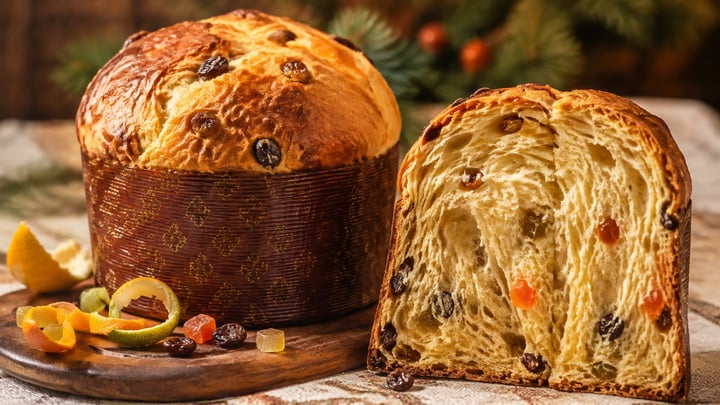
In Brazil panetone belongs to Christmas the way stollen does elsewhere, and it is not a fruit loaf: it bakes in a tall paper mould and the crumb turns stringy — you pull it apart rather than slice it. Forty-five minutes of work and about five hours of rising, most of it the dough working on its own.
Ingredients
- 500 g bread flour
- 100 g sugar
- 10 g dried yeast (or 30 g fresh)
- 4 eggs
- 150 ml warm milk
- 120 g soft butter
- 1 tsp salt
- Zest of 1 orange and 1 lemon
- 1 tsp vanilla extract
- 150 g diced candied fruit
- 100 g raisins
- Juice of 1 orange for soaking
- 1 paper panetone mould (500 g)
Method
- 1
Put the raisins and candied fruit in a bowl with the orange juice and leave them to soak while you make the dough. Drain them well before folding them in: extra liquid softens the crumb.
- 2
Dissolve the yeast in the warm milk with a spoonful of the sugar and wait 10 minutes until it foams.
- 3
Mix the flour with the remaining sugar and the salt. Add the eggs, the yeast, the zest and the vanilla, and knead until it comes together.
- 4
Work in the soft butter a little at a time, without rushing. The dough turns sticky and then recovers: knead 15 minutes until it pulls away from the bowl and turns elastic.
- 5
Cover and leave to double, 2 to 3 hours depending on how warm the kitchen is.
- 6
Knock it back gently, fold in the drained fruit and raisins, and shape it into a ball without overworking it or you lose the air.
- 7
Transfer to the paper mould and leave to rise again until it reaches two fingers below the rim, about 2 hours.
- 8
Score a cross on top and bake at 170 °C for 45 minutes. If it browns early, cover it with foil.
- 9
As soon as it comes out, push two long skewers through near the base and hang it upside down until cold. That step is what stops the crumb collapsing under its own weight, and it is where the height comes from.