Napoleon: Russian Puff Pastry Layer Cake
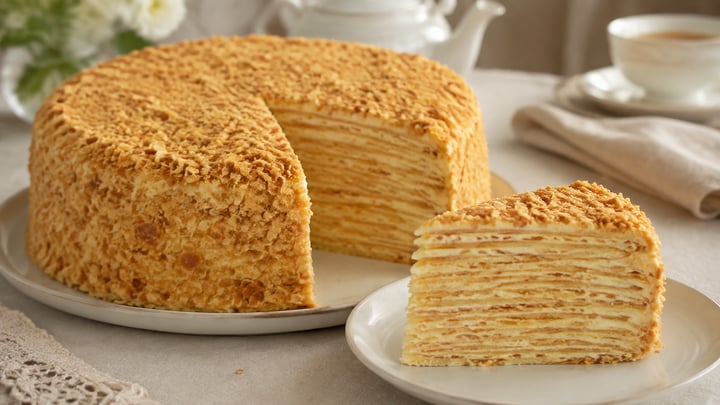
Twelve paper-thin layers of puff pastry with a pastry cream enriched with butter, and the crumbs of the trimmings on top. It is one of the best-loved cakes on the Russian table, and its decisive step happens not in the oven but in the fridge: freshly assembled it crackles and will not slice; twenty-four hours later the layers have absorbed the cream and it turns tender and melting — which is the whole point of it. The dough takes vinegar rather than the vodka of Soviet recipe booklets: it does the same thing to the gluten and it is in every kitchen. The story goes that the cake was created in Moscow in 1912 for the centenary of the victory over Napoleon, served in triangular pieces shaped like his bicorne hat.
Ingredients
- — For the pastry —
- 500 g plain flour
- 250 g cold butter, cubed
- 1 egg
- 150 ml iced water
- 1 tbsp white vinegar
- 1 tsp salt
- — For the cream —
- 1 litre whole milk
- 4 eggs
- 250 g sugar
- 80 g plain flour
- 200 g soft butter
- 1 tsp vanilla extract (or 2 tsp homemade vanilla sugar)
- 1 pinch of salt
Method
- 1
Mix the flour with the salt and rub in the cold butter with your fingers until you have lumps the size of a chickpea. Do not work it in completely: those pieces of butter are what separate the layers later.
- 2
Beat the egg with the iced water and the vinegar and pour it over the flour. Bring it together by hand only until it forms a ball — do not knead. The vinegar lowers the pH and weakens the gluten, which is what lets the dough roll out thin without shrinking back.
- 3
Divide the dough into 12 equal portions, flatten them into discs, wrap them and chill for at least 2 hours. Work with one at a time and keep the rest cold: warm butter ruins the layering.
- 4
Heat the oven to 200 °C. Roll each portion out on greased paper until very thin, about the size of a 24 cm plate, and trim the edge using a plate so they all match. Keep the trimmings: they are the crumbs for the top.
- 5
Prick the whole surface with a fork. Without that the dough puffs into uneven blisters and the layer stops being flat.
- 6
Bake each layer for 5 to 7 minutes, until golden and dry. Two at a time if the oven allows. Move them to a rack: stacked hot, they go soft.
- 7
Bake the trimmings until golden too and, once cold, crush them by hand into coarse crumbs.
- 8
For the cream: whisk the eggs with the sugar and flour until smooth. Heat the milk, pour a ladleful into the egg mixture while whisking to temper it, and only then return everything to the pan.
- 9
Cook over medium heat, stirring constantly and reaching the bottom, until it thickens and a lazy bubble breaks the surface. Take it off the heat, stir in the vanilla and salt, and cool it with cling film pressed onto the surface so no skin forms.
- 10
Only once the cream is at room temperature — not before — beat the soft butter until pale and work the cream in a spoonful at a time. If the cream is warm the butter melts and the mixture splits.
- 11
Assemble the cake alternating pastry and cream, and do not be sparing: the cream is not a filling, it is what softens the layers. Finish with cream on top and around the sides, and cover the whole thing with the crumbs.
- 12
Cover and refrigerate for 24 hours. This is the step that makes the cake: freshly assembled it crackles and will not slice; the next day it is tender. Longer does not improve the texture and only shortens the life of a cream made of egg and milk — eat it within three days.
- 13
⚠️ Shortcut: ready-made puff pastry works, rolled out very thin and cut into discs the same way. Plenty of people do it that way now, and it turns a weekend project into an afternoon.