Pan de Jamón – Venezuelan Christmas Ham Bread
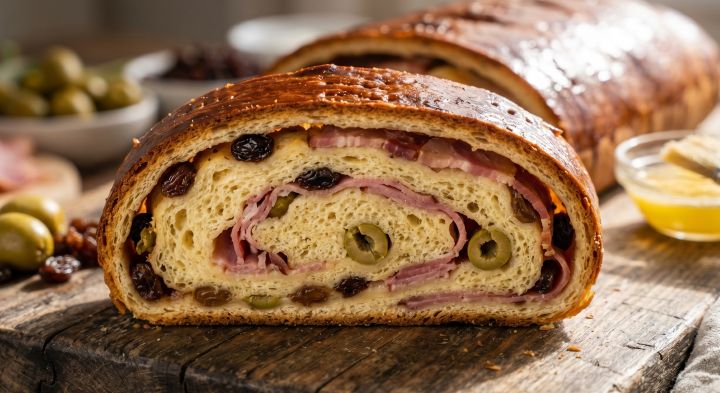
Pan de jamón is to a Venezuelan Christmas what pan dulce is to an Argentine one: an enriched yeast dough, rolled out and covered with cooked ham, bacon, raisins and green olives, then rolled up and baked. Sweet and salty at once — that is not an accident, it is the principle of the dish.
Two moves decide the result. The olives are drained and patted dry: their brine softens the dough from the inside. And the loaf is pricked all over with a fork before baking, so the steam escapes and the roll does not burst open.
Ingredients
- 500 g all-purpose flour (plain flour)
- 7 g dried yeast (or 20 g fresh yeast)
- 250 ml warm whole milk
- 50 g sugar
- 50 g melted butter (plus extra for brushing)
- 1 egg
- 1 tsp fine salt
- 400 g cooked ham, thinly sliced
- 200 g smoked bacon, in strips
- 100 g dark or golden raisins
- 100 g green olives, pitted
- 1 egg beaten with a tablespoon of sugar, to brush before baking
Method
- 1
Activating the yeast: in a jug with the warm whole milk, dissolve the yeast along with a tablespoon of the sugar from the recipe. Leave it for 5 to 10 minutes at room temperature until foam starts to form on the surface.
- 2
The base dough: put the flour in a large bowl and make a well in the centre. Pour in the milk with the activated yeast, the rest of the sugar, the melted butter, the egg and the teaspoon of fine salt (keeping the salt from touching the concentrated yeast directly). Work the ingredients together from the centre outwards into a rough ball.
- 3
First rise: turn the dough onto the worktop and knead it energetically for 8 to 10 minutes until you have a smooth, elastic, even ball. Put it in a lightly oiled bowl, cover it with cling film or a clean tea towel and let it rise somewhere warm for 1 hour, or until it has doubled in volume.
- 4
Rolling out and laying on the filling: divide the dough into two equal portions to make two loaves. Roll out the first into a rectangle 2 to 3 mm thick. Spread half the strips of raw bacon evenly over it, cover with half of the sliced ham and scatter half of the raisins and olives (you can put a row of olives along the starting edge so they sit in the centre when you slice it). At this point it is crucial to drain the green olives well and pat them dry with kitchen paper before spreading them over the ham. Leave a clear 2 cm margin at the far end.
- 5
Rolling and pricking: roll the dough up tightly, starting from the side with the row of olives, up to the clear edge. Dampen that edge lightly with water and seal the join well, pressing with your fingers. Put the loaf on a buttered tray with the seam underneath. Repeat with the second loaf. Prick the entire surface of both loaves with a fork so the steam can escape.
- 6
Second rise and glazing: let the shaped loaves rest on the tray for 30 minutes. Meanwhile, heat the oven to 180 °C. Before they go in, brush the whole surface with the beaten egg and sugar mixture.
- 7
Baking and finishing: bake at 180 °C for 30 to 35 minutes, or until the bread has taken on a deep, glossy golden colour. Take them out and, if you want extra shine and a softer crust, brush them immediately with a cube of cold butter. Let them cool a little before cutting into thick slices and serving.