Gelatin or agar-agar: when you can swap them and when you can't
Agar replaces gelatin in many recipes, but not all of them and never in the same amount. When the swap works, when it doesn't and how to adapt the recipe.
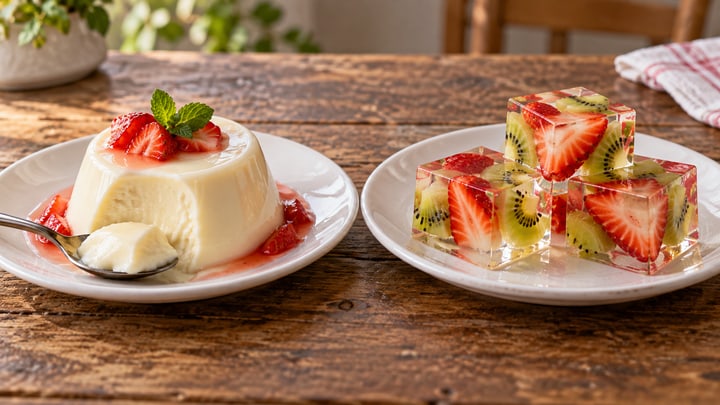
Agar-agar can replace gelatin, but not always and never in the same amount. Both turn a liquid into something firm, but they do it at different temperatures and with different textures: gelatin melts in the mouth and agar doesn't. That's why the swap works perfectly in a fruit or layered dessert, and changes the nature of a mousse. Before swapping, it's worth asking what the gelatin is doing in that recipe.
When agar works just as well or better
Fruit and juice jellies. Agar gives a cleaner, clearer cut. And with raw kiwi, pineapple, papaya or mango it's the only option: their enzymes break down animal gelatin.
Layered desserts. Agar sets in minutes at room temperature and only melts above 85 °C, so a warm layer won't melt the one below. What takes an afternoon with gelatin takes an hour with agar.
Desserts that have to withstand heat, on an outdoor table or served warm.
Firm puddings and creams meant to be unmolded, where each portion should stand on its own.
When it has to be gelatin
When the dessert should melt in the mouth. Gelatin melts at body temperature; agar doesn't. In a mousse, a Bavarian cream or a creamy panna cotta, agar makes a tasty dessert, but a firmer, sliceable one.
Foams and airy preparations. Marshmallows, whipped mousses, the Bavarian cream in a charlotte: gelatin holds the air with elasticity. With agar the air stays trapped, but the foam turns brittle.
Anything that has to stretch, like gummy candies. Agar has no elasticity: it snaps.
Cold mixtures with whipped cream. Agar sets at around 40 °C, so poured hot onto a cold cream it instantly forms strings and lumps. Gelatin goes in warm and gives you time.
Anything going in the freezer. Agar weeps water as it thaws.
What about savory food?
Agar works for savory jellies, terrines and aspics, and it's widely used in Japanese cooking. The difference, again, is texture: with agar a terrine is firmer and doesn't melt as you eat it.
Many savory dishes, besides, have no added gelatin: it comes on its own from the collagen in bones and skin. That's what makes a homemade stock set in the fridge, and what holds Russian kholodets together. There's nothing to replace there: if you want a version without animal gelatin, it's a different recipe.
How to adapt a recipe
Amount. Agar is stronger: you use a lot less. As a starting point, 2 g of agar powder for each envelope of gelatin (7 g) in half a liter of liquid. Strength varies by brand, so the first time it's worth testing a spoonful on a cold plate and adjusting.
Disperse it cold. Sprinkle the powder over the cold liquid and whisk before heating.
Boil. One or two minutes at a gentle boil. Where the recipe said «dissolve the gelatin in the warm liquid», agar has to boil: otherwise it won't set.
Acid last. Lemon juice or tart fruit juice goes in with the heat off: boiled with the agar, it weakens it.
Mixtures with cold dairy. Heat all the liquid together with the agar, instead of adding hot agar to a cold base. If the recipe doesn't allow it, temper: mix the hot agar first with part of the base and then with the rest, quickly and whisking.
If it didn't turn out as expected
It didn't set: almost always, it didn't boil long enough. Bring it back to a boil for a minute or two and pour it again.
It's hard or rubbery: there was too much agar. Melt it by boiling with a little more liquid.
It's firm but you wanted it creamy: once cold, blend it in a blender or with a stick blender. You get a soft, silky gel you can use like a cream.
Frequently asked questions
Can I replace gelatin with agar in any recipe?
No. It works well in fruit jellies, layered desserts and firm creams. For mousses, foams, gummy candies and desserts that go in the freezer, it's better to stick with gelatin, because agar doesn't melt in the mouth and has no elasticity.
How much agar equals an envelope of gelatin?
As a starting point, about 2 g of agar powder replaces a 7 g envelope of gelatin for half a liter of liquid. Strength varies by brand, so it's worth testing first.
Why won't gelatin set with pineapple or kiwi?
Raw pineapple, kiwi, papaya and mango contain enzymes that cut the proteins in gelatin. Cooked or canned, this no longer happens, because heat deactivates the enzymes. Agar isn't a protein, so it sets anyway.
Can you make mousse with agar-agar?
You can, but you get something else: firmer and sliceable instead of creamy and melting. If you want the classic texture, gelatin is the way to go.