How to make a Christmas popcorn garland
Make a sturdy popcorn garland in two days, learn where to pierce each piece, whether it is edible afterward, and which colorful accents work best.
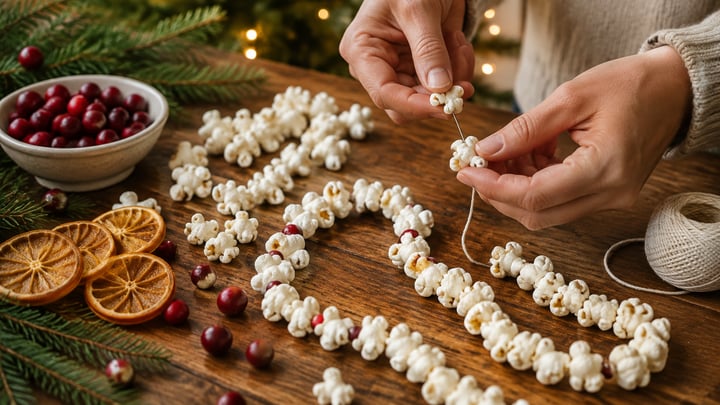
Popcorn garlands are a nostalgic North American Christmas craft. Elsewhere — including New Zealand, where Christmas falls in summer — many people recognize them from movies rather than family tradition. Wherever you are, the useful trick is the same: make the garland over two days. Pop plain popcorn on day one and let it dry overnight; string it on day two. Stale popcorn is firmer and far less frustrating to work with.
Day 1: pop it plain and let it dry
Use plain popcorn with no sugar, salt, or butter. An air popper is ideal; if you use a pot, add only as much oil as needed. Seasoning makes the thread greasy or sticky and can attract pests.
Choose large, fully opened pieces and spread them uncovered on a sheet pan (baking tray). Leave them in the driest part of the house for 12 to 24 hours. Partially popped kernels are too hard to pierce safely.
Make a separate batch for snacking. Once popcorn has been set out and handled for the craft, it has a different job.
Day 2: string short sections
Thread a large embroidery needle — preferably blunt-tipped — with strong cotton thread. Work in 3- to 5-foot sections (1 to 1.5 meters). Shorter strands tangle less, are easier to repair, and can be tied together at the end.
Pierce the thick, white center of each piece rather than a delicate wing. Ease it over the needle and slide it down gently. Do not pull hard from the far end: the thread can saw straight through the popcorn.
Tie a large knot at both ends, then join sections with a double knot. Children can plan the pattern and pass pieces to an adult, but an adult should handle the needle.
Cranberries and other pops of color
The classic American look alternates four to six pieces of popcorn with one fresh cranberry. Choose firm berries, dry them thoroughly, and pierce through the center.
For a longer-lasting strand, use fully dried orange slices, dried rose hips, unpainted wooden beads, or small ribbon bows. Avoid juicy berries and soft dried fruit: they release moisture, stain the popcorn, and encourage mold.
In warm or humid climates — especially a Southern Hemisphere summer Christmas — fresh cranberries shorten the garland’s life. Assemble close to the holiday, check it daily, or choose an all-dried pattern.
Is it edible afterward? No
Treat the finished garland as decoration, not food. It has passed through hands, needle, and thread and may hang for days collecting dust or touching tree sap, ornaments, and pet hair. If you add any craft sealant, it is absolutely inedible.
Keep it indoors in a dry spot, away from candles, heaters, and damp windows. Remove it at the first sign of an off smell, soft fruit, or mold. Before composting untreated plant material, cut out every piece of thread so wildlife cannot become tangled in it.
The easiest rule: one bowl for eating, one batch for decorating.
Frequently asked questions
Why should popcorn sit overnight?
Fresh popcorn is softer and breaks easily when pierced. After 12 to 24 hours exposed to dry air, it becomes firmer and much easier to string.
Can you eat a popcorn garland after Christmas?
No. After handling and days of exposure to dust and the tree, it should be treated only as decoration. A sealed or sprayed garland is never edible.
What can I use instead of cranberries?
Fully dried orange slices, dried rose hips, unpainted wooden beads, or small ribbon bows. Avoid soft, moist fruit.
How long will it last?
A dry indoor garland made with dehydrated accents can last through the holiday season. Check fresh fruit daily and discard the strand if it becomes damp, smells off, or develops mold.