How to store fresh herbs
Parsley, cilantro (coriander), and basil wilt in two days if left loose in the refrigerator (fridge). With the right method, they last one or two weeks — and there is one that does not go in the refrigerator.
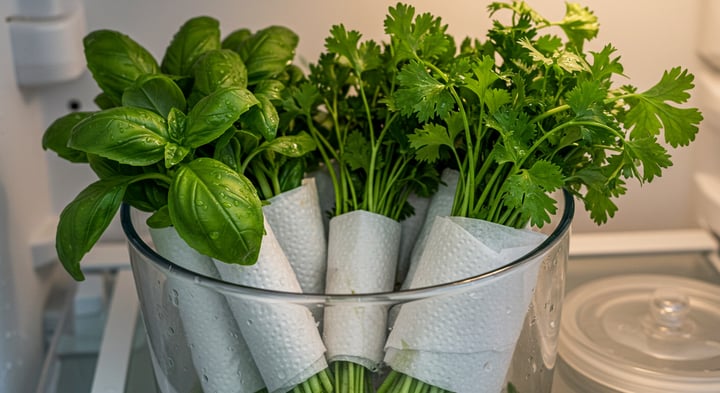
Fresh herbs are bought in large bunches and used by the sprig, so there is almost always some left over. The problem is that loose in the refrigerator they wilt in two or three days: they dehydrate if the air is dry, and they rot if they remain wet. All preservation comes down to controlling moisture, and there are two families of herbs that handle it differently.
Two families, two methods
The tender ones —parsley, cilantro, dill, chives, mint— have soft stems and high water content. They should be stored like a bouquet of flowers: stems in a jar with 1-2 inches of water, a loose bag over the top so they do not dry out, and into the refrigerator. They last a week or more, and it is easy to see when to change the water.
The woody ones —rosemary, thyme, oregano, sage— have hard stems and less water. They should be wrapped in a barely damp paper towel, inside an airtight container or a bag, and into the refrigerator. They last two or three weeks.
The rule that applies to both: the paper should be damp, not wet. If it drips, the herb will rot on the side that touches it.
Basil is the exception
Basil does not go in the refrigerator: with the cold, the leaves turn black in a day. It should be stored like a bouquet, in water, at room temperature and away from direct sunlight. This way it lasts almost a week and may even sprout roots.
It is the herb most often lost by storing it "properly," and it is the only one that is ruined precisely because of that.
Washing before or after
Washing before storing only works if they are then dried thoroughly: in a salad spinner or between two kitchen towels (tea towels). An herb stored wet lasts half as long.
If there is no time to dry them well, it is better to store them unwashed and wash them when using them.
Freezing: for cooking, not for finishing
Chopped and frozen in an ice cube tray with olive oil, herbs last for months and come out ready to toss into the skillet (frying pan). This works for parsley, cilantro, rosemary, and thyme.
What is lost when freezing is the texture: a frozen herb works well in a stew, a sauce, or a stir-fry, but not for sprinkling raw over a dish. For that, there is no replacement for a fresh bunch.
Frequently asked questions
Can basil be stored in the refrigerator?
Better not: with the cold, the leaves turn black in a day. It goes in a jar with water, at room temperature and without direct sunlight.
How long do fresh herbs last when stored properly?
The tender ones —parsley, cilantro, dill— one week or a little more. The woody ones —rosemary, thyme, oregano— two or three weeks.
Is it better to wash them before storing?
Only if they are dried thoroughly afterwards, with a spinner or between kitchen towels. Stored wet they rot; if there is no time to dry, wash them when using them.
Are frozen herbs good for everything?
For cooking, yes: stews, sauces, stir-fries. For sprinkling raw, no, because they lose their texture when thawed.