What an Eggshell Tells You
The float test measures how old an egg is, not whether it has gone bad. The porous shell also answers whether to wash eggs, whether to refrigerate them and why your egg whites will not whip.
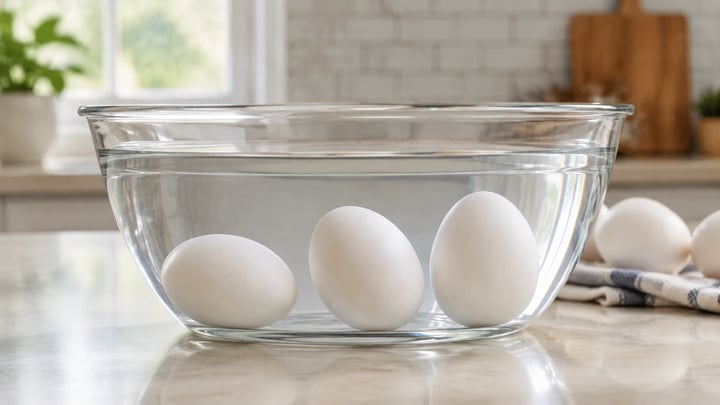
An eggshell is porous, and almost everything worth knowing follows from that single fact. Over time water evaporates out and air moves in: the air cell at the blunt end grows, the egg loses density and eventually floats. That is why the float test measures age, not condition — an old egg can be perfectly good, and a contaminated one can sink just the same. The same porosity explains why washing eggs is a bad idea, why refrigeration is a one-way decision, and why eggs pick up smells.
The float test: what it actually measures
Lower the egg into a glass of cold water and watch how it settles. What you are measuring is how much air has worked in through the pores since it was laid — in other words, its age.
Floating does not mean rotten. A well-kept egg ages, floats and is still perfectly edible. And the reverse: salmonella contamination does not produce enough gas to lift an egg, so a dangerous egg can sink without giving anything away.
The popular shorthand — "it floats, it is off" — makes people throw out good eggs and trust bad ones. For a test, that is the worst possible combination.
Not pass or fail, but a scale
Lying flat on the bottom: very fresh, a few days old. This is the one you want to poach.
Tilted, blunt end up: a couple of weeks. Fine for anything.
Standing on end on the bottom: old, but usually still good. The best candidate for hard-boiling.
Floating: quite old. Do not bin it: crack it into a separate bowl and smell it.
Your nose is the real test
There is only one way to find out whether an egg has gone bad: open it. A rotten egg announces itself with an unmistakable sulphurous smell that leaves no room for doubt.
That is why you crack it into a separate bowl before it joins anything else. A single bad egg ruins the dozen, the cake and the afternoon, and once it is in there is no way back.
Why washing eggs is a bad idea
An egg comes with a natural coating that seals the pores, the cuticle or bloom. Washing it off with water lets surface bacteria in where they could not get before.
This is where countries part ways. In the UK and the EU, washing eggs for retail sale is prohibited, and eggs are sold and kept at room temperature. In the United States eggs are washed as a matter of regulation, and precisely because of that refrigeration is required. Both systems are coherent; they just start from opposite ends.
If an egg arrives dirty, clean it dry: a paper towel, a cloth, or gently rubbing it. That is exactly the egg that most needs to keep its cuticle.
And if washing is unavoidable, the water must be warmer than the egg — so the contents expand and push outward rather than drawing inward — and use it straight away rather than returning it to storage.
Fridge or worktop
It depends on whether they were washed, which is why the answer changes with where you live. In the UK and Europe, with the cuticle intact, eggs keep well on the worktop. In the United States, where they arrive washed, they must stay refrigerated.
⚠️ Either way it is a one-way decision. An egg that has been chilled and comes back to room temperature sweats on the outside, and that film of water carries bacteria inward through the pores. Once it goes in the fridge, it stays there.
And because of the same porosity: do not store them next to anything strongly scented. An egg takes up garlic, onion and fish through the shell, and that smell turns up later in the omelette.
Cracking: where and how
On a flat surface, not on the rim of a bowl. The rim drives shell splinters and whatever is on the outside into the egg; a short tap on the worktop opens a clean crack.
And always into a separate container, for the reason above: cracking straight over the mixture is the habit that ruins everything one day.
Separating whites without losing the meringue
One drop of yolk and the whites will not whip. Yolk is fat, and fat stops the white proteins from forming the network that traps air.
So separate each white into a small bowl and only then add it to the rest. If the fourth one goes wrong you lose one white, not four.
And avoid plastic bowls: they hold a film of grease that washing up does not remove, and that film is enough to ruin the whole thing. Metal or glass, thoroughly dry.
Age matters here too: the white of a fresh egg is thick and whips to a firmer foam, while an older white is looser, rises faster and collapses sooner.
Frequently asked questions
How do I know if an egg has gone bad?
By cracking it into a separate bowl and smelling it. A spoiled egg has an unmistakable sulphurous smell. The float test does not answer this: it measures age, not condition.
Is an egg that floats bad?
Not necessarily. Floating means a lot of air has worked in through the pores, which means it is old. A well-kept old egg can be perfectly fine; crack it separately and smell it before deciding.
Should eggs be washed before storing?
No. Washing removes the cuticle, the natural coating over the pores, and after that bacteria can get in. If an egg is dirty, clean it dry. If you must wash it, use water warmer than the egg and use it immediately.
Do eggs belong in the fridge?
It depends where you are. In the UK and Europe eggs are sold unwashed and keep well at room temperature; in the United States they are washed by regulation and must be refrigerated. Either way, once an egg has been chilled it should stay chilled.
Why will my egg whites not whip?
Almost always fat: a drop of yolk in the whites, or a plastic bowl holding a film of grease that washing up does not shift. Separate each white into a small bowl and use metal or glass, thoroughly dry.