Why a Dough With a Lot of Butter Rises Slowly (and What Happens if You Rush It)
Three kings bread, panettone, stollen: enriched doughs take twice as long to rise and the commonest mistake is speeding them up with heat. Why it happens and what to do instead.
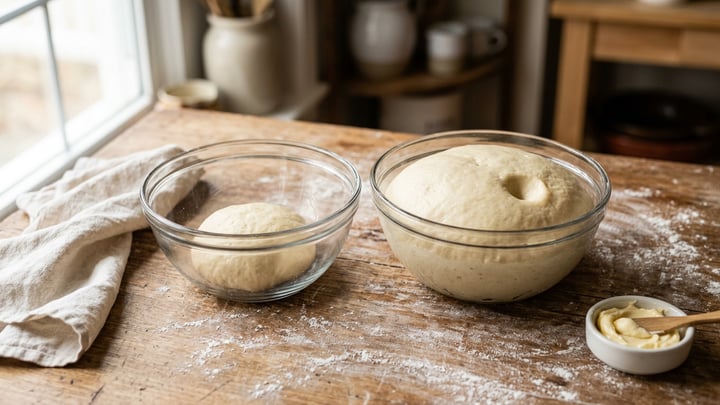
A dough with a lot of butter rises two to three times more slowly than plain bread dough, and there is nothing wrong with it: the fat coats the gluten strands and slows down both the network that holds the gas and the yeast itself. The near-universal mistake is trying to fix that with heat — next to the oven, on the radiator. That is exactly what melts the butter, separates it from the dough and ruins the very crumb you were after.
What is going on inside
The yeast makes gas and the gluten forms the network that holds it. With a lot of fat, the butter wraps around the gluten strands and insulates them from each other: the network still forms, but more slowly and shorter — which is why these doughs never have the elasticity of bread.
The fat also gets in the yeast’s way; it works less well surrounded by butter than in a lean dough. The two add up: gas is harder to produce and the network holds it less well.
Why heat does not fix it
The butter in an enriched dough is soft, not melted, and that is the whole point: in that state it stays spread through the dough. Melt it and it separates, then runs out during baking, leaving a dry crumb and a greasy base.
The ideal is 24 to 26 °C ambient. Above 30 the butter starts to give, and next to the oven the surface of the dough sits well above that even while the centre is still cold.
What to do instead
Give it the time: where a bread dough doubles in an hour, these want two or more. That is not a safety margin, it is how long they take.
And if the kitchen is cold, instead of more heat use the oven switched off with the light on, or put a bowl of hot water in the bottom. That gives you a few degrees evenly, with no hot spot to melt anything.
The signal is volume, not the clock: doubled means ready. A floured finger pressed into the dough should leave the dent without it springing straight back.
The other half: add the butter late
If the recipe says so, knead first without the butter and work it in gradually after a few minutes. With the butter in from the start the gluten never develops and the dough stays heavy however long it rises.
It is the difference between a loaf that pulls apart in strands and one that crumbles.
Frequently asked questions
How long should a dough with a lot of butter rise?
Two to three hours for the first rise, against one for plain bread dough. The clock is only a guide: the real signal is that it has doubled in volume.
Can I let it rise in the fridge overnight?
Yes, and it usually improves the flavour. It rises far more slowly but evenly, and the butter is in no danger. The next day let it come to room temperature before shaping.
And if nothing has happened after three hours?
It is almost always the yeast, not the butter: check that it was not out of date and that the milk was not hot when you dissolved it. Above 50 °C the yeast dies.