Dough for Arab Turnovers
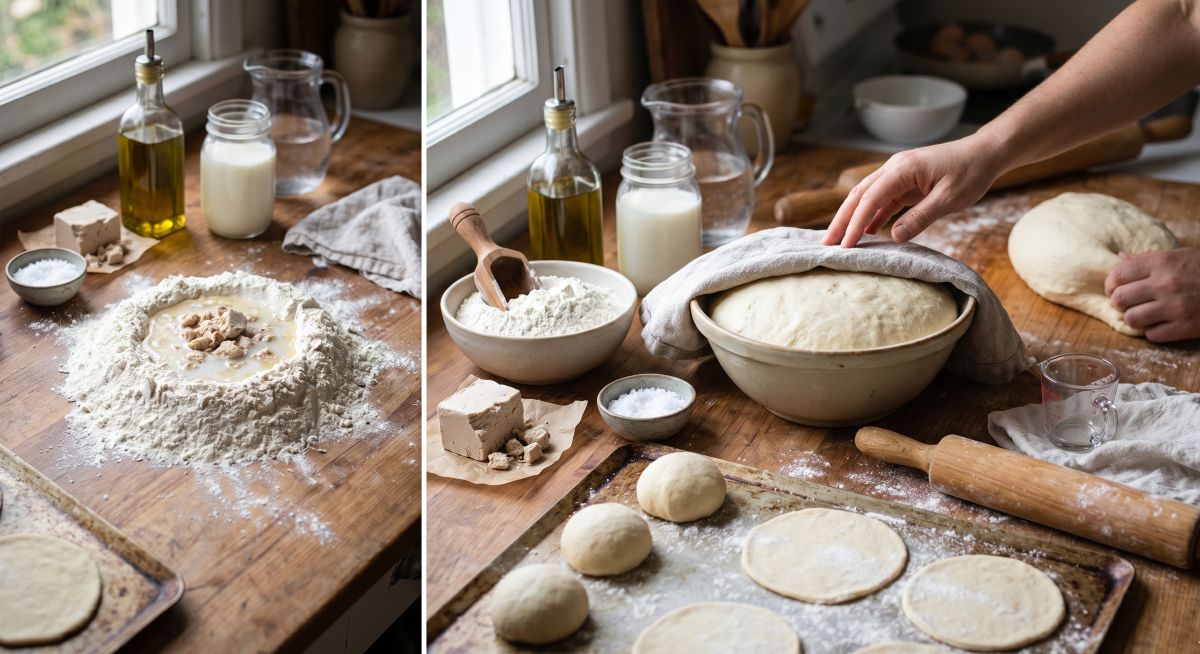
The base dough for fatayer and lahmacun, as the Syrian-Lebanese immigration brought it to northern Argentina. Its elastic, soft texture comes from the combination of water and milk, while fresh yeast gives it its characteristic lightness. This recipe makes about 30-35 turnovers.
The distinctive part is the liquid: half water, half milk. The milk makes the dough softer and more pliable than water alone would, and it browns faster in the oven.
One move that often gets overlooked: the salt goes on the outer rim of the flour, not onto the yeast. Direct contact draws water out of the yeast and slows it down.
Try it with these fillings: meat: fatayer and lahmacun, cheese, mint and ricotta and chard and ricotta.
Ingredients
- 1 kg all-purpose flour (plain flour)
- 20 g fresh yeast
- 1 level tbsp salt
- 4 tbsp olive oil
- 300 ml water
- 300 ml milk
Method
- 1
Make a well in the flour and put the yeast in the middle. Scatter the salt around the outer rim so it does not touch the yeast: direct contact draws water out of it and slows it down.
- 2
Add the water, the milk and the oil a little at a time. Start bringing it together from the centre outwards.
- 3
Knead energetically for 10 minutes until you have a smooth, elastic, even dough.
- 4
Put it in an oiled bowl, cover with a damp cloth and leave it to rise somewhere warm for 1 hour, until it has doubled in volume.
- 5
Knock the dough back by pressing gently to release the air.
- 6
Cut balls of 30-35 g each (it makes about 30-35 of them).
- 7
Roll each ball out into circles 1 to 2 mm thick with a rolling pin.
- 8
Let the discs rest on a floured tray for 20 minutes before filling. Without that pause the dough shrinks back on its own while you are filling it.