Pan de Campo – Argentine Country Bread
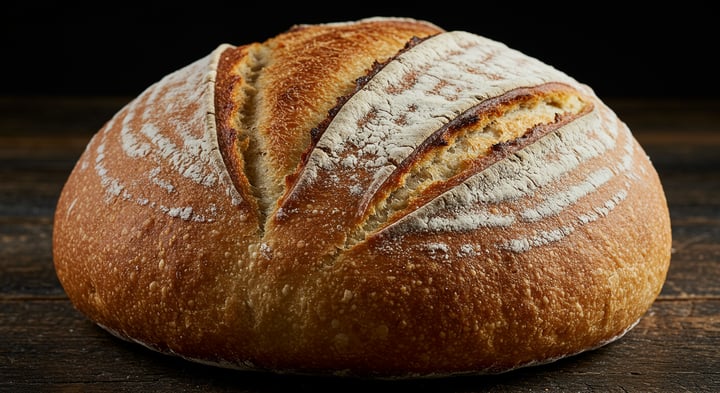
The country bread of the Argentine estancias: a round, firm crust and a compact, substantial crumb. A beginner's bread — four ingredients and no particular technique.
The optional fat is what separates it from any ordinary white loaf: classically it takes beef dripping, which softens the crumb and keeps the bread fresh for more days. Butter does the same job, with a milder flavour.
One move that appears throughout this recipe and has a reason: the salt goes on the outer rim of the flour, never directly onto the yeast — salt draws water out of it and slows it down.
When some is left over and goes stale, do not throw it out: this is exactly the bread the bread pudding asks for.
With the same patience but rye and oats instead, you get the zeppelins, one roll each.
🔎 What is beef suet? — where it comes from, what goes in it and how it differs.
Ingredients
- 500 g strong bread flour
- 300 ml warm water
- 25 g fresh yeast (or 1 sachet of dried yeast, 7 g)
- 10 g fine salt (about 1 full tsp)
- 1 tsp sugar (to activate the yeast)
- 25 g beef dripping or butter, at room temperature (optional, for a softer crumb)
Method
- 1
Activating the yeast: in a jug with a third of the warm water, dissolve the yeast along with the teaspoon of sugar and a tablespoon of the flour. Cover and leave it for about 10 minutes until a foamy sponge forms.
- 2
The crown of flour: in a large bowl, or directly on a clean worktop, make a crown with the flour. Scatter the salt around the outer rim, so it does not touch the yeast directly at the start and inhibit it.
- 3
Bringing it together: pour the yeast sponge into the centre of the crown. Start adding the rest of the warm water a little at a time, along with the fat if you have decided to use it, working the flour in from the centre outwards.
- 4
Kneading: once the dough has come together, knead it energetically on the worktop for 10 to 15 minutes. Stretch the dough with the heel of your hand and fold it back until it is smooth, soft and elastic.
- 5
First rise: shape a smooth ball, put it in a lightly oiled or floured bowl, cover it with a clean cloth and leave it somewhere warm for 1 hour, or until it has doubled in volume.
- 6
Knocking back and shaping: turn the dough onto the worktop and press it gently with your fists to release the built-up gas. Shape it into a round or oval loaf, pulling the surface taut underneath.
- 7
Second rise: put the loaf on a floured baking tray. Cover it again and let it rise for another 30 minutes.
- 8
Scoring: just before it goes into the oven, dust the surface with a little flour and make a clean cross (or three parallel cuts) with a very sharp knife or a blade, about 5 millimetres deep.
- 9
Baking: cook in an oven preheated to a hot 200 °C for about 35 to 40 minutes. You will know it is ready when tapping the base with your knuckles sounds hollow. Let it cool on a rack before cutting.