Tamales Salteños – Argentine Corn Parcels
The traditional technique of grinding the corn, the role of the beef suet, and how to wrap them in corn husks. A reliable regional recipe from northern Argentina.
The corn is boiled with clean wood ash. That is not folklore: the alkali loosens the hull so it can be removed, and it is the same principle as Mexican nixtamalization. Without it the grain stays tough and the dough will not come together.
And the filling is completely sealed inside the dough before the parcel is wrapped. Any gap and the filling escapes into the cooking water.
🔎 What is beef suet? — where it comes from, what goes in it and how it differs.
Ingredients
- 1 kg yellow corn kernels
- 1 kg roast beef, boiled and chopped
- 500 g potatoes, boiled and chopped
- 200 g scallions (spring onions), sliced
- 3 hard-boiled eggs, chopped
- 200 g butter
- Beef suet, as needed
- 1 tsp paprika, mixed with a little suet
- Dried corn husks, boiled for 1 minute
- Brine (salted water)
- Salt, chili flakes and cumin, to taste
- Clean wood ash, for the traditional grinding
Method
- 1
Grinding the corn: boil the kernels for 60-70 minutes in water with clean wood ash to loosen the hulls — the alkali is what makes the grain workable, the same principle as nixtamalization. In a mortar or food processor, crush the kernels, adding splashes of brine until you have a pliable dough. Work in the butter.
- 2
The filling: cook the scallions in beef suet. In a separate bowl, mix the finely chopped meat with the potatoes, the scallions and the hard-boiled eggs. Season generously with cumin, chili flakes and paprika.
- 3
Assembly: shape a disk of dough in the palm of your hand. Put the filling in the center, leaving a free border, and close the tamal making sure the filling is completely sealed inside.
- 4
Wrapping: wrap each one in a boiled husk, shaping it like a wrapped sweet. Tie the ends firmly with strips of the same husk to keep the seal.
- 5
Boil the tamales in salted water over gentle heat for 20 minutes, so the flavors come together.
- 6
Drain and serve hot, inside their husks.
Frequently asked questions
What is the difference between a tamal and a humita?
From the outside they are identical: both are wrapped in corn husks and tied the same way. The difference is inside, and it is fundamental.
In a humita, the corn is the dish: fresh corn is grated, seasoned, and that is the filling. In a tamal salteño, the corn is the wrapper: dried corn is boiled with ash to loosen the skins and ground into a dough, and that dough encloses a filling of meat, potato and hard-boiled egg.
Put simply: with a humita you eat corn; with a tamal, the corn is the dough that wraps the meat.
The season differs too. A humita needs fresh corn, so it is a summer dish; the tamal is made with dried corn and works all year round.
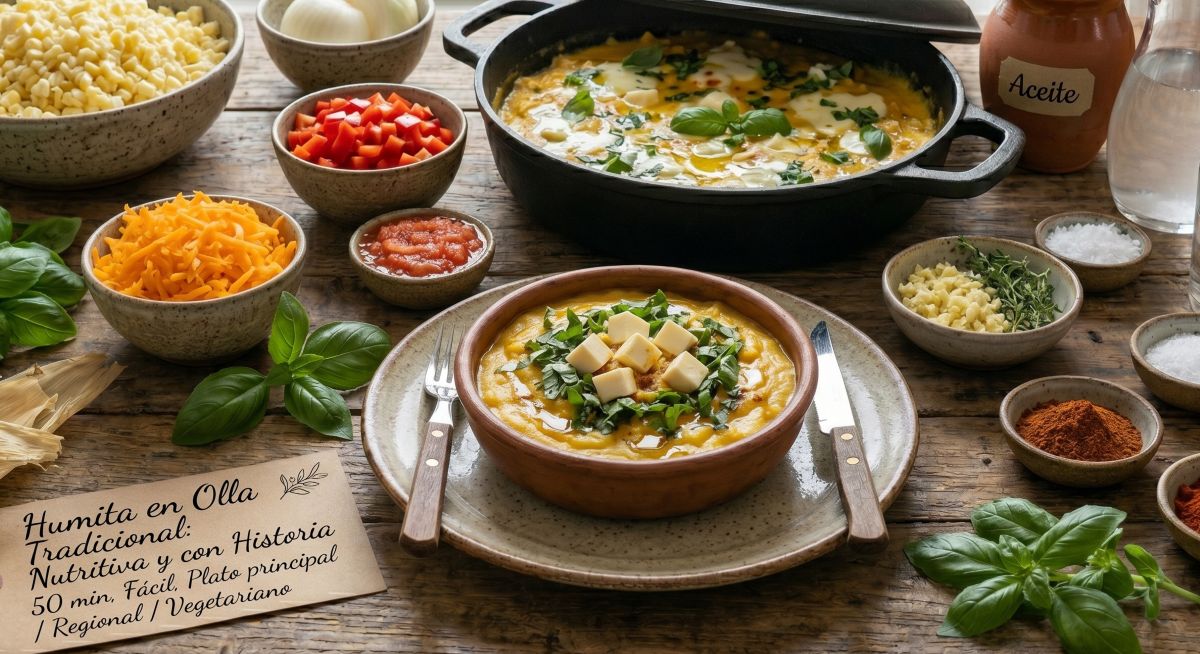
If it was the other one you were after, here it is: Humitas en Chala – Steamed Corn Parcels.
What is inside a tamal salteño?
Two clearly separate layers.
The dough is dried yellow corn, boiled with ash and ground with brine until pliable. It carries grasa de pella (beef kidney fat) and sweet paprika, which is where the colour comes from.
The filling is made separately and ends up completely sealed inside: boiled beef chopped very fine, potato, spring onion softened in grasa de pella, and hard-boiled egg, seasoned with cumin, ground chilli and paprika.
What it does not contain: no Mexican chilli sauce and no dough made from pre-cooked corn flour. The tamal salteño is boiled, not steamed, and the husk is tied into a sweet-wrapper shape.
Can they be frozen? How do you reheat them?
Yes — and it is the best reason to make all 12 at once: the tamal freezes very well because the husk protects it.
To freeze: let them cool completely inside the husk, still tied. They keep for up to 3 months. If you unwrap them first, the dough dries out.
To reheat, straight from frozen:
- In water (best): 15 to 20 minutes in salted water, exactly as in the original cooking.
- Steamed: 20 minutes.
- Microwave: 2 to 3 minutes, husk dampened and covered.
In the fridge they keep for 3 days, always in the husk. What you should not do is reheat them already opened — the dough dries out immediately.
Can I use bicarbonate of soda instead of ash?
Yes, absolutely 🌽 Bicarbonate of soda works perfectly and the result will be just as good. It does the same chemical job as the ash: it creates an alkaline environment that softens and loosens the hard skin of the corn kernel.
🥄 The right proportion is 1 tablespoon of bicarbonate of soda per litre of cooking water.
💧 One key tip: rinse the corn kernels very thoroughly under plenty of clean water after boiling them. That is essential for removing the bits of skin and any excess bicarbonate before they go into the mortar or the food processor.
What is the ash for, and where does it come from?
The ash is used to hull the corn — a process similar to nixtamalisation. The alkaline environment loosens the hard skin from the kernel and makes it more digestible. It has to be ash from pale, untreated wood (from a barbecue fire), with no plastic or chemical residue.
Modern substitute: if you have no ash to hand — the normal situation in a flat — use bicarbonate of soda or food-grade lime, one tablespoon per litre of water.
Do you eat the corn husk?
No, definitely not. The dry corn husk (the chala) is both cooking vessel and wrapping: it holds the moisture inside and gives the characteristic rustic aroma. At the table it is opened like a present — only the filling is eaten.
What is grasa de pella?
It is the purest beef fat, taken from around the kidneys — what English-speaking kitchens call suet. It matters because of its high melting point and the characteristic flavour that defines the Salta tamal. Ask a butcher for beef suet; it is also sold already rendered as beef dripping.
Is this an Andean recipe?
Absolutely. The tamal is a pillar of Andean cooking. The corn tamal of the Calchaquí valleys is the fullest expression of the culture of north-western Argentina, with pre-Hispanic roots it shares with Bolivia and Peru. Cooking of the high country: corn and patience.
Are they always made with yellow corn?
No, not at all. Yellow corn is very popular and gives the dough its characteristic golden colour, but white corn (hulled white corn) is just as traditional in many parts of north-western Argentina — some would say more so.
Andean cooking has an enormous range of corn varieties, but for tamales salteños the argument is always between white and yellow:
White corn: usually the favourite of purists and of the oldest recipes. It gives a paler dough with a slightly more neutral, earthier flavour, which lets the filling — and the paprika in the beef suet — take the lead completely.
Yellow corn: gives the dough that vivid, appetising colour, along with the faintest sweetness that contrasts nicely with the salty, spiced filling.
Both are correct and traditional. In fact the ash process for hulling the kernels works exactly the same way for either one.
Flavors of Salta
The soul of Argentina's northwest in your kitchen. A run through the Andean inheritance of corn, slow fire and deep flavors that take you there with every bite.