How to clean mushrooms
Wash or brush? The sponge myth, measured: how much water mushrooms really absorb, why they sometimes refuse to brown, and how to dry them so they do.
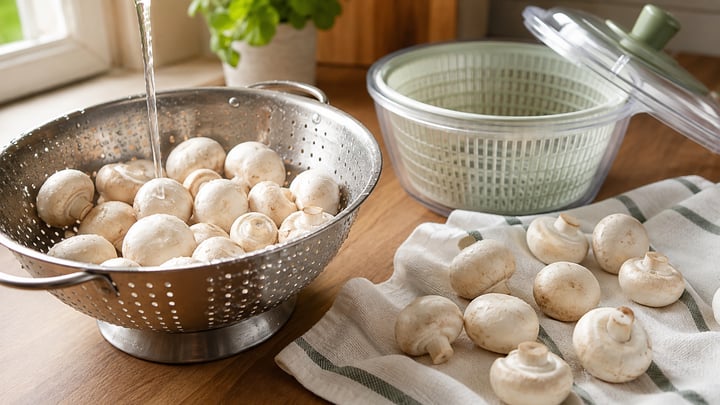
The argument about whether mushrooms may be washed or must be wiped dry comes up in every kitchen, and almost always with the same line: they soak up water like a sponge. It has been measured, and it is a large exaggeration. What is true is that a wet mushroom will not brown — but the culprit is not the water inside it, it is the water on it. And that is solved by drying, not by avoiding water.
The sponge myth, in numbers
The test has been run many times and comes out much the same: 170 g of whole mushrooms held under water for five minutes gain around 6 grams. About 2%. A twenty-second rinse falls far below that.
They are not sponges, for two reasons. The skin of the cap is fairly water-repellent, and the flesh is already 90% water: there is not much room left to take on more.
What does absorb is cut flesh — open surface. Hence the rule that orders everything else: wash them whole and slice afterwards. Never the other way round.
Why they sometimes refuse to brown
The water that ruins a sauté is the water on the outside. In the pan it evaporates first, and evaporating costs heat: the temperature drops, the mushroom releases its own juice and ends up steaming instead of browning. The result is grey, limp and free of any roasted flavour.
But exactly the same thing happens to bone-dry mushrooms if the pan is merely warm, or crowded. Water is not the sole cause, then — it is one of three ways to cool a pan. Drying well, getting the pan properly hot and cooking in batches deals with all three.
How to wash them properly
Whole, and at the last minute. Wash them right before cooking, never when you get home from the shop: wet, they spoil far faster.
Cold water, quickly. In a colander under the tap, turning them with your hand, twenty or thirty seconds. No soaking.
A salad spinner. This is the best tool for the job and not a workaround: it removes the bulk of the water without bruising them. Whole mushrooms take it perfectly well — slices get battered, which is one more reason to cut afterwards.
A few minutes in the air. The spinner leaves a fine film that is best left to evaporate on its own, on a tea towel or kitchen paper, before the mushrooms meet the pan.
When brushing is enough
The cultivated mushroom is grown indoors, on pasteurised compost, under a casing layer of sterilised peat. What you see clinging to the base of the stem is that substrate — not field soil with manure in it.
And if the mushroom is then going to spend a few minutes in a hot pan, the microbiological side takes care of itself. For mushrooms that will be cooked, brushing or a barely damp cloth is more than enough.
It is a different matter if they are going to be eaten raw, in a salad or as carpaccio. There, washing genuinely helps, and the safety argument outweighs the one about texture.
The ones that want different treatment
Dried mushrooms (porcini, shiitake) are soaked, not washed. And the soaking liquid goes through a coffee filter before you use it: it carries a great deal of flavour, but also the grit, which settles at the bottom.
Morels and foraged mushrooms really are washed. Their hollow, folded structure collects genuine dirt, and there the risk is real.
Fresh shiitake has a woody stem: take it off and keep it for a stock. On the cultivated mushroom, by contrast, the stem is as good as the cap and goes in with it.
Store them dry
What shortens a mushroom's life is trapped moisture. The film-wrapped tray and the supermarket plastic bag both sweat, and after two days the mushrooms are slimy and blotched.
In a paper bag in the fridge they keep for close to a week: the paper takes up the moisture they release and lets them breathe. If they come in a tray, it is worth moving them the moment you get home.
Frequently asked questions
Can mushrooms be washed in advance?
Better not. Washed, they last a day at most: moisture accelerates spoilage. Wash them right before cooking and otherwise keep them dry, in a paper bag.
Do mushrooms need peeling?
No. The skin of the cap is thin, edible and precisely the part that stops them taking on water. Peeling only makes sense on a very large, mature portobello, and then for texture rather than cleanliness.
Do you throw the mushroom stem away?
No. On the cultivated mushroom the stem is as tender and flavourful as the cap, and it is close to a quarter of the mushroom. Only the dry tip of the base comes off. The woody stem you discard is a shiitake matter.
They are already sliced and dirty — now what?
Barely damp kitchen paper, slice by slice, or accept the rinse and dry them very thoroughly. Cut, they really do absorb, so drying counts double: a very hot pan and cooking in batches.