The ice bath: cooling down what you have just cooked
Why a hot dish should not go straight into the fridge, how to set up an ice bath that cools it in minutes, and why it is worth leaving it uncovered while it comes down.
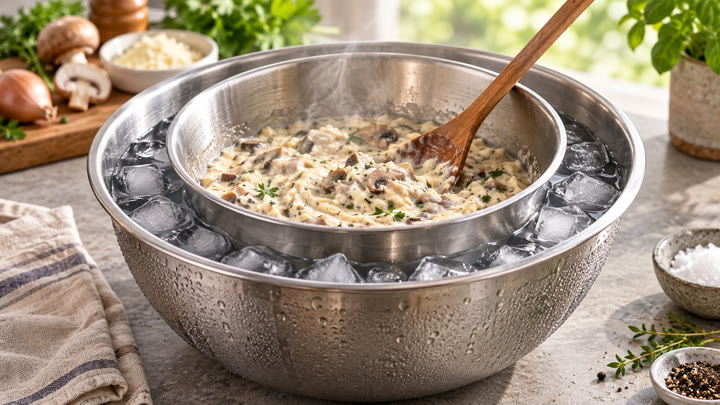
Something just off the heat takes hours to cool on its own, and those hours are usually exactly the ones the recipe asks you to wait before carrying on. An ice bath is the classic water bath, reversed: instead of sitting the container in hot water, you sit it in water and ice. It works for the same reason the hot version works — water moves heat far better than air does — only in the other direction.
Why air is such a poor cooler
Water conducts heat roughly twenty-five times better than air. That is not a difference of degree: it is why a container on the counter seems never to cool, and the same container in iced water drops in temperature while you watch.
And air behaves even worse than that number suggests. The air around the container warms up, stays put and forms a tepid layer that insulates it from the rest. Water, by contrast, touches the whole wall, carries the heat away and renews itself through convection.
So an ice bath is not «a bit faster»: it changes the scale of the problem, from hours to minutes.
How to set one up
You need a container larger than the one you want to cool. Cold water halfway up, then ice on top: water first, ice second, because dry cubes trap air between them and air is precisely the problem.
The container with the food sits inside, not floating. If it floats, weigh it down or use a heavier one: what cools is the wall in contact with the water, and a floating container offers very little of it.
The water level has to sit above the contents, not above the rim. If the water reaches the rim, it gets in.
Stirring the contents now and then speeds things up considerably: it brings the hot centre out to the cold wall, which is where the exchange happens.
The shape of the container matters more than the amount of ice
What governs the speed is the ratio of surface to volume. A wide, shallow container cools far faster than a tall, narrow one holding exactly the same food, because it offers more wall per spoonful.
Which gives you the trick with the best return and no cost at all: splitting it between two containers cools better than adding more ice to the one you have.
Material counts too. Metal conducts far better than plastic, and plastic better than thick glass. A steel tray with the food spread out is the fastest thing within reach in any kitchen.
Uncovered while it cools, covered when you store it
Leaving it uncovered helps, for two reasons: the lid is one more barrier, and the steam escaping carries heat away with it as it evaporates.
It is worth knowing where the gain comes from, though. The bulk of the work is done by the walls in contact with the water, not by the open surface on top. Uncovering adds to it; it is not what decides. If you had to pick one thing, it is the wide container, not the lid.
And it has an expiry date: once the food is cold, cover it before it goes into the fridge. Uncovered it picks up smells, dries out on the surface and sits exposed. Uncovered is for the cooling stage, not for storage.
Why the hurry
Between 5 °C and 60 °C bacteria multiply comfortably, and food left to cool on its own spends several hours inside that band. The usual food-safety reference is to go from 60 °C down to 21 °C within two hours, and from 21 °C down to 5 °C within four hours more.
A large, full pot on a kitchen counter can take considerably longer than that, especially in summer. An ice bath is the domestic way of meeting that clock without having to think about it.
It is also why hot food should not go straight into the fridge: besides taking just as long, it raises the temperature of everything already in there.
If you are genuinely in a hurry: salt
A handful of coarse salt in the iced water lowers the melting point and takes the mixture well below zero. It is the same trick used to chill a bottle in minutes, and it pays off here just as well.
It is for cooling fast, not for holding: the salted mixture exhausts itself sooner. The order that works is to cool with salt and then store in the fridge.
Why salt does that is covered in how to keep drinks cold, which is the same principle applied to a bottle.
What not to do
Do not put hot glass straight into iced water: thermal shock can crack it. With glass, let it lose the first burst of heat on the counter and only then move it to the bath.
Do not let water get into the food. If the container is shallow, use less water and change it more often.
Do not walk away and come back an hour later. The ice melts and the water turns tepid: once the water has stopped being cold, it has stopped cooling. Changing the water costs nothing and restores the full speed.
And do not treat an ice bath as licence to keep something longer: cooling fast extends the life of a dish, it does not make it eternal.
What you need
- ice-water bath — between 0 and 4 °C
- ice-water bath with coarse salt — between -10 and 0 °C
- refrigerator — between 2 and 8 °C
- bacterial danger zone — between 5 and 60 °C
Frequently asked questions
How much faster does an ice bath cool than the counter?
A great deal faster, because water conducts heat about twenty-five times better than air. In practice the jump tends to be from hours to minutes, but it depends more on the shape of the container than on the amount of ice: a wide, shallow one makes far better use of the bath than a tall, narrow one.
Should the container be covered or uncovered?
Uncovered while it is cooling: the lid insulates and the escaping steam carries heat away. Once cold, covered for storage. That said, the big gain comes from the walls being in contact with the water, not from the open surface.
Can hot food go straight into the fridge?
Better not. It takes as long or longer, and meanwhile it raises the temperature of everything already inside. A fridge is built to hold things cold, not to bring them down.
Does it work without ice?
Yes, quite well. Cold tap water already conducts far better than air; the thing to do is change it as it warms. It does not match ice for speed, but it beats the counter comfortably.
Can the container break?
Glass can, through thermal shock, especially if it is very hot and the bath very cold. Metal and hard plastic do not have that problem. With glass, let it come down a little in the air before it goes into the iced water.