How to keep drinks cold
Ice, salt, coolers and clay jugs: why ice alone chills slowly, how to cool a bottle in minutes and how to stop the ice from watering the drink down.
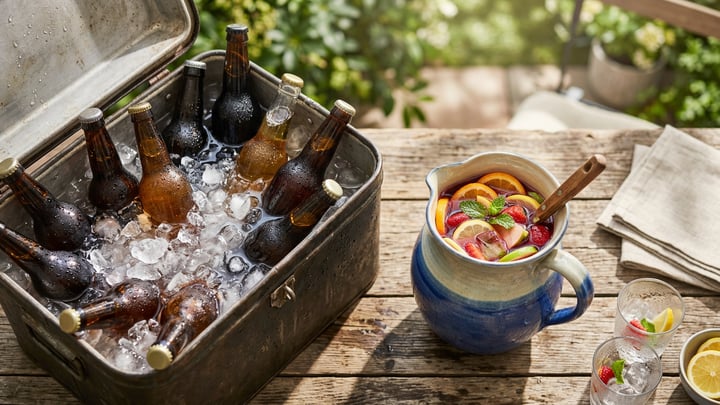
Keeping a drink cold is an easier problem than keeping one hot, for a physical reason: ice is a free thermostat. Melting absorbs vastly more energy than warming by a degree, so as long as ice remains the mixture sits near zero on its own, with no power and no supervision. Heat has no equivalent. What changes is the enemy: hot drinks degrade, cold drinks get diluted. Almost everything else follows from those two sentences.
Ice does not chill — melting ice chills
A cube at freezer temperature chills almost nothing while it stays hard. What actually absorbs heat is the change of state: going from ice to water consumes on the order of eighty times the energy of raising the melted water by one degree.
From that follows the most important and least intuitive point: a bottle buried in dry cubes cools slowly. The air between the cubes insulates, and the real contact is a handful of points.
The same quantity of ice, with water added, cools far faster, because the water touches the whole bottle and conducts.
Ice, water and salt: from an hour to ten minutes
Adding salt to that ice-and-water mix lowers the melting point, and the brine sits well below zero. The result is a bath far colder than ice alone, in full contact with the glass.
It is the difference between waiting an hour and waiting a few minutes, and it requires buying nothing. A generous handful of coarse salt in the cooler with ice and water is enough.
⚠️ It is for chilling fast, not for holding: brine is spent sooner than plain ice. The order that works is chill with salt, then hold with ice and water.
Dilution is the real enemy
Anything that chills with ice ends up watering the drink down, and that problem has no counterpart in the hot article. There are three ways around it.
Keep the ice off the drink. Chill the bottle or jug in the ice bath and pour without ice in the glass. It is what any bar does with wine and beer.
Large cubes instead of small ones. The same mass of ice in large cubes has far less surface area, so it melts slower and chills almost as well. The small cubes from the tray are the worst choice for a long drink.
Freeze part of the drink itself. Coffee cubes for iced coffee, lemonade cubes for lemonade, frozen grapes or strawberries in a jug. They chill and, as they melt, change nothing about the flavour.
What goes at which temperature
Colder is not always better: below a certain point the aromas shut down and only the cold sensation is left.
Beer and anything carbonated belong at the low end of the fridge range. White and sparkling wine a little above; red wine in the wine-cooler range, which in summer is not the room temperature of a house.
And there is a physical reason not to let fizzy drinks go warm: gas dissolves less well at higher temperatures, so a warm soft drink loses its carbonation faster and tastes flat.
The cooler, and the mistake of opening it
The same rule as the vacuum flask, mirrored: more cold is lost through openings than through the walls. A cooler opened every two minutes performs a fraction of what it could.
It should also be full. The air in the empty space warms first, so a half-full cooler lasts far less than a full one. If there is room left, fill it with bottles or more ice, not with air.
And chill the contents beforehand: the ice in the cooler is there to hold, not to bring down a soft drink that has been sitting in the sun.
The botijo: chilling without power and without ice
A botijo is a Spanish jug of porous clay that seeps a little water through its wall. That water evaporates, and evaporating carries heat away: the water inside sits below the ambient temperature — no ice, no power, no moving parts.
The Indian matka and the African zeer pot work on the same principle. It works better the drier and airier the surroundings, and hardly at all in humid, enclosed air.
It is the exact mirror of the samovar: a pre-electric object solving a thermal problem with physics rather than energy. What a samovar is can be found in the entry on what a samovar is.
Double-walled glasses and carafes
They work like a vacuum flask with the sign reversed: they insulate, they do not chill. They hold what is already cold, and they do not sweat, so they leave no puddle on the table.
For a jug that will sit two hours on a sunlit table, an insulated carafe outperforms a glass one with twice the ice.
If something has to be cold right now
The ice bath with water and salt is the fast route. A can or single bottle in that mixture, turned every so often, drops in temperature within minutes.
Turning the bottle matters more than it seems: it moves the liquid inside and renews the layer against the cold glass.
⚠️ The freezer works but is risky with sealed containers: liquid expands as it freezes and a glass bottle can burst. If used, set a timer and keep it short.
What not to do
Do not use ice made from cloudy or off-tasting water: in a clear drink everything shows, and in the glass ice is another ingredient.
Do not stack bottles on top of the ice hoping the cold will rise. Cold does not rise: the bottle has to be surrounded, not rested on top.
And do not freeze a whole jug of a fizzy drink to get ahead: the carbonation goes and does not come back.
The reverse problem — holding a drink hot without boiling it — needs appliances, because heat has no equivalent of ice: how to keep a drink hot without boiling it.
What you need
- cooler with ice, water and salt — between -18 and 0 °C
- refrigerator — between 2 and 8 °C
- wine cooler — between 6 and 12 °C
- double-walled glass or carafe — between 2 and 12 °C
- botijo (porous clay jug) — between 12 and 18 °C
Frequently asked questions
Why does ice with water chill faster than ice alone?
Because the water touches the whole surface of the bottle and conducts heat, while dry cubes leave air between them, which insulates. The same amount of ice performs far better with water added.
What is the point of salting the ice?
It lowers the melting point, so the mixture sits well below zero. It is the fastest way to chill a bottle without a freezer. For chilling fast, not for holding.
How do I stop ice from watering my drink down?
Chill the bottle or jug in an ice bath and pour without ice; use large cubes rather than small ones; or freeze part of the drink itself, which changes nothing as it melts.
Can a bottle be chilled in the freezer?
Yes, but set a timer. Liquid expands as it freezes and a sealed glass bottle can burst. The ice bath with water and salt is faster and carries no such risk.
How does a botijo work?
The porous clay lets a little water through to the outside; that water evaporates and carries heat away, so the water inside stays below the ambient temperature. It works best in dry, airy conditions.