How to Keep a Drink Hot Without Letting It Boil
Vacuum flask, variable-temperature kettle, samovar, Glühweinkocher or slow cooker: which device holds which drink for hours, and why boiling ruins it.
Keeping a drink hot for hours is a different problem from heating it. At a long party, a market stall or a winter table the drink has to stay in range without boiling, and each one is ruined in its own way when it goes over: mate is scorched, tea turns astringent, wine loses alcohol and the spices turn bitter, milk curdles and catches on the bottom. The simplest answer is a vacuum flask. After that comes a whole family of devices — the variable-temperature kettle, the samovar, the German mulled-wine urn — each solving a different version of the same problem, depending on whether what is held hot is the water or the finished drink.
What boiling ruins
Boiling is not a cosmetic problem: in each drink it breaks something different.
In South American mate, water at a full boil scorches the leaf. The first infusion turns bitter and the leaf is spent far sooner; that is why it is poured at 70 to 80 °C.
In tea something similar happens by another route: water that is too hot over-extracts tannins and the cup turns astringent. Black tea tolerates very hot water; green does not.
In mulled wine, ethanol evaporates well before the liquid bubbles, and past a certain point the loss accelerates. At the same time more tannins are extracted, which is what leaves that dry harshness at the end of the sip. What remains is a sweet, flat spice juice.
With milk or chocolate the problem is physical: the protein coagulates, a skin forms on the surface and the bottom sticks and scorches.
Two problems wearing the same coat
Infusions are not kept hot. What is kept hot is the water, and the drink is built one cup at a time. The risk sits at the moment of brewing: if the water reaches the leaf too hot, the infusion is already spoiled.
Finished drinks — mulled wine, chocolate, punch, cider — cannot be built per cup with twenty guests. The whole drink has to be held, and there the risk is time: every hour on the heat degrades it a little more.
Two families of devices come out of that fork, and it explains a cultural asymmetry: traditions built around infusions never had to solve the mulled-wine problem, because their drink is remade in every cup.
The easy answer: the vacuum flask
It is the only passive device on the list: it gives off no heat, it only slows the fall. For an afternoon that is enough, provided three things are respected.
Preheat it. A flask at room temperature spends a good part of the first fill just tempering its own walls. Fill it with hot water, discard, and only then add the drink.
Fill it to the top. The air in the headspace is what accelerates the loss most: a half-full flask performs far worse than a full one. And open it as little as possible, because more heat is lost through openings than through the walls: eight cups served over three hours are eight openings.
They are not all the same. The silvered glass liner — the original design — insulates better than steel, because glass conducts far worse and the silvering blocks radiation; it lost the market for being fragile, not for performance. Double-walled vacuum stainless steel is tougher and slightly weaker at insulating, particularly at the neck where the two walls meet. Anything double-walled but not evacuated is not a vacuum flask but an insulated jug, and belongs in another category. The stopper counts just as much: a push-button lid leaves a channel open and leaks continuously, while a plain screw stopper holds noticeably better.
How long it really holds. The figure on the box is measured full, preheated, sealed and never opened, and down to a low threshold: "still warm", not "still in range". Here the case is different, because the flask is loaded with the drink already at serving temperature, around 75 °C rather than 95. Since the loss is proportional to the gap with the room, starting lower shortens the useful window sharply: to fall below 65 °C only a fifth of that gap has to be lost, and in a good flask that happens in about two hours. The same flask that is still warm at twelve hours leaves the serving range at two. Two hours cover most gatherings; a long afternoon they do not, and that is what the devices below are for.
The variable-temperature kettle
In Argentina this is the standard device for the problem, because mate is drunk there: an infusion of dried leaf refilled from the same gourd over hours. The appliance exists for one reason — to hold water at a chosen temperature without ever boiling.
It works for any infusion built per cup, not only mate. What the leaf is and how it is chosen is in the entry on yerba mate.
⚠️ It is a device for water. Spiced wine does not go in: sugar and pulp scorch on the heating element, and the residue is very hard to clean out of a narrow neck.
The concentrate model: samovar and çaydanlık
There is an older solution that separates the two halves: hot water on one side, a very strong concentrate of the infusion on the other. Each cup is built by mixing the two in whatever proportion is wanted.
The samovar is the canonical case, and it works the opposite of what its shape suggests: the tap does not pour tea, it pours hot water. The concentrate — the zavarka — sits in a small pot on top. The Turkish çaydanlık is the same idea without electricity: two stacked kettles, water below, strong tea above.
The advantage is not folkloric. Nothing sits for hours on the heat: the concentrate is made once, and water does not degrade from being hot. That is the underlying reason this scheme ages better than holding the drink already mixed.
⚠️ Its water sits very hot, close to boiling — which is right for black tea and the opposite of what mate or green tea need. What it is exactly and how it works inside is in the entry on what a samovar is.
The Glühweinkocher
A tall electric urn with a thermostat and a tap at the base. It is the device on every stall at the German Christmas markets, and in Germany an ordinary household appliance through December; outside that world almost nobody knows it.
It solves both halves at once: it holds the drink inside the serving range and it is served from the tap, without lifting a lid, without stirring and without raising a full pot.
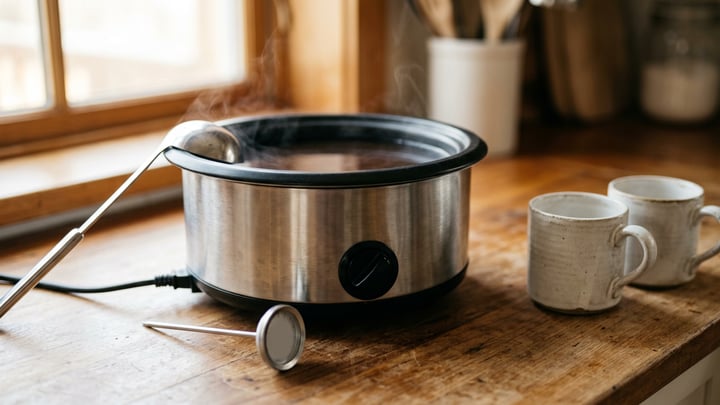
The slow cooker
The most widely available answer in English-speaking kitchens: punch, cider or mulled wine for a long party, in volume and unattended.
⚠️ The detail that decides the result: use "keep warm", not "low". Low reaches 90–95 °C after a couple of hours, well above the serving range, and by then the drink has boiled. It is the most frequent error in the recipes in circulation.
The electric fondue pot
The wildcard, because outside Europe it is the easiest thermostat-controlled device to find. Heat the drink in a pan, transfer to the fondue, set it to the lowest setting: it sits at constant temperature in the middle of the table.
⚠️ Models running on burning paste or spirit will not do. The open flame concentrates heat at the base and scorches the liquid while the surface stays lukewarm.
What is not enough: the mug warmer
Heated coasters and thermal mugs solve a different problem, and it is worth knowing before buying one for this.
It is not a matter of brand but of power. A USB port delivers between 2.5 and 4.5 watts; an open mug sheds on the order of 15 to 20, mostly through evaporation. With that gap nothing can be held: the fall can only be slowed.
That is why the whole category is calibrated around 50 to 55 °C, the temperature at which coffee is still comfortable to drink. It falls below the floor for a spiced drink.
The step almost nobody takes: straining
Holding the drink for hours with the cinnamon, cloves and star anise still in it turns it bitter. The clove keeps releasing eugenol long after the infusion is done, and that bitterness cannot be corrected with sugar.
The correct order is: infuse, strain, and only then hold. Strained, a spiced drink lasts the whole afternoon without changing flavour.
The reverse problem — keeping a drink cold — is solved the other way round, because there the ice is a free thermostat and the enemy is dilution: how to keep drinks cold.
What you need
- vacuum flask — between 65 and 75 °C
- variable-temperature electric kettle — between 70 and 85 °C
- samovar or çaydanlık — between 85 and 95 °C
- Glühweinkocher (German urn with a tap) — between 65 and 75 °C
- slow cooker on "keep warm" — between 70 and 75 °C
- electric fondue pot with thermostat — between 65 and 75 °C
- mug warmer — between 50 and 55 °C
Frequently asked questions
What temperature is mulled wine served at?
Between 65 and 75 °C. Below that it feels lukewarm and the spices do not come through; above it, it starts losing alcohol and the tannins show.
Can the kettle be used for mulled wine?
For water yes, for wine better not. Sugar and pulp scorch on the element and are hard to remove. If what is wanted is a thermostat-controlled device, the electric fondue pot does the same job without that cost.
Does a USB mug warmer work?
To stop coffee going cold, yes. To hold a spiced drink in range, no: the power of a USB port is several times smaller than what an open mug sheds.
How long does a vacuum flask keep a drink hot?
It depends what goes in. Full, preheated and unopened, a good flask stays warm for many hours. But loaded with the drink already at serving temperature, it leaves the range in about two hours: the figure on the box measures something else.
Can it be reheated the next day?
Yes, as long as it does not boil and the spices have already been strained out. If they stayed in, each reheating makes it a little more bitter.