What is agar-agar?
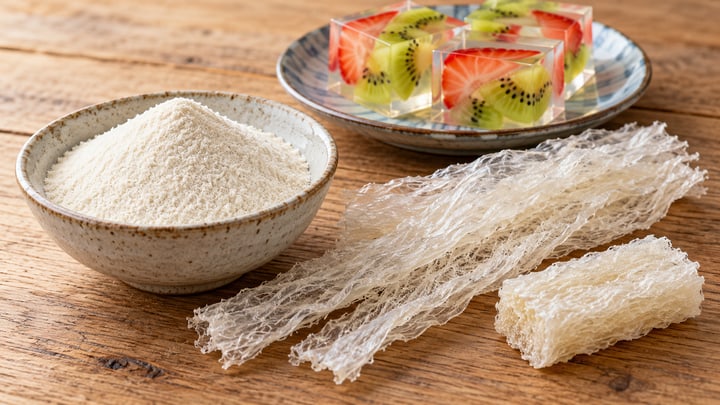
Agar-agar is a plant-based gelling agent extracted from red seaweed, and it does the same job as gelatin: it turns a liquid into something that holds its own shape. But it doesn't behave the same way. Gelatin, which comes from animals, dissolves in warm liquid, sets slowly in the fridge and melts in your mouth. Agar has to boil, sets in minutes at room temperature and doesn't melt until it's above 85 °C: it gives a firm, clean cut and holds up outside the fridge. Being vegan is one of its advantages, not the only one.
Where it comes from and how it's sold
It's made from red seaweed, mainly from the Gelidium and Gracilaria genera. In Japan it has been used for centuries under the name kanten, which is also the name of the desserts made with it.
It's sold as a powder, as flakes and as dried bars or strands. The powder is the easiest to use and the one almost every recipe calls for: it's easy to measure and dissolves evenly. The three forms can't be swapped in the same amount: the powder is much more concentrated, so if a recipe calls for powder, use powder.
Agar and gelatin: the difference is temperature
To dissolve. Gelatin blooms in cold water and dissolves in a warm liquid. Agar needs to boil for a minute or two: if it only dissolves, it won't set.
To set. Gelatin needs the fridge and several hours. Agar starts to set at around 40 °C, within minutes and without cold: that's why the molds have to be ready before you turn off the heat.
To melt. Gelatin melts at body temperature, which is where that melt-in-the-mouth feeling comes from. Agar only melts above 85 °C: not in your mouth, and not on a table in the sun.
In texture. Gelatin is elastic and wobbles. Agar is firmer and more brittle: it cuts cleanly, but it doesn't stretch.
When agar is the better choice
With raw kiwi, pineapple, papaya or mango. These fruits contain enzymes that break down gelatin and stop it from setting. They do nothing to agar.
When the dessert has to withstand heat, such as on a summer table, or be served warm.
For layered desserts. Each layer sets in about 10 minutes and the next one can go on warm without melting it. With gelatin, each layer needs an hour in the fridge.
For vegan, vegetarian, halal or kosher tables, where animal gelatin is off the menu.
When gelatin is the better choice
When the whole point is that it melts in your mouth: mousses, Bavarian cream, creamy panna cotta. With agar they turn firmer and sliceable, which is a different dessert.
In foams and airy preparations, such as marshmallows or a charlotte. Gelatin holds the air with elasticity; agar holds it too, but brittle.
In anything that has to stretch, such as gummy candies: agar snaps.
If it's going in the freezer. Agar weeps water as it thaws.
The details of what happens in each case, and how to adapt a recipe, are in the tip on when you can swap gelatin for agar.
How to use it without it failing
Disperse it cold. Sprinkle the powder over the cold liquid and whisk before heating: if it lands in a hot liquid, it forms lumps that won't dissolve.
Let it boil. One or two minutes at a gentle boil, stirring. It's the step people skip most often and the most common reason it doesn't set.
Acid goes in last. Lemon juice, passion fruit or vinegar weaken agar if they boil with it. Add them with the heat off.
As a starting point, with powder: about 3 g per liter gives a soft gel that barely wobbles; 5–6 g per liter gives a firm, clean-cutting gel, like kanten. Strength varies from brand to brand, so the first time it's worth testing a spoonful on a cold plate.
If it set too soon, it isn't lost: bring it back to a boil and it melts again.
Where to buy it
In health food stores, Asian grocery stores and well-stocked supermarkets, usually as a powder in sachets or small jars. It goes a long way: a 50 g jar is enough for dozens of desserts.
Keep it somewhere dry and tightly sealed; it lasts for years.
The recipes
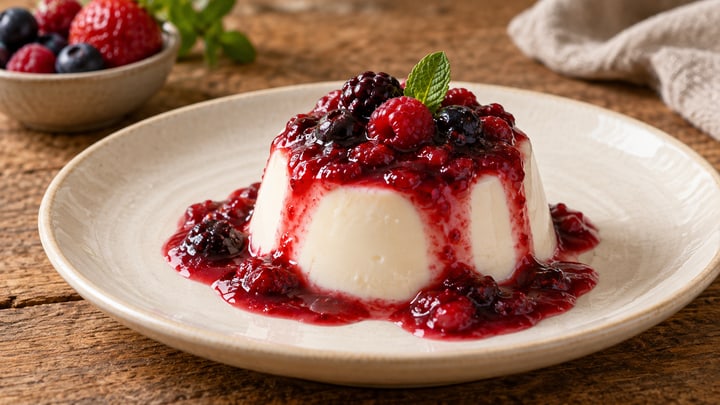 Vegan Coconut Panna Cotta with Agar-Agar
Panna cotta with agar instead of gelatin: firmer than the classic, dairy-free, and it unmolds in one piece.
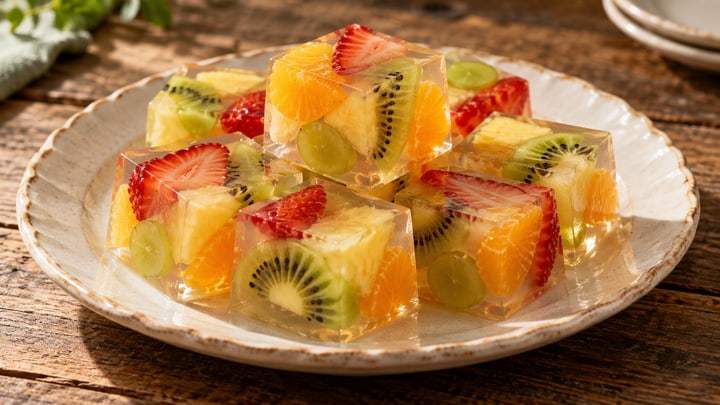 Kanten: Japanese Fruit Jelly with Agar-Agar
The Japanese dessert that gave agar its name. It uses fresh kiwi and pineapple, exactly the fruits that won't set with gelatin.
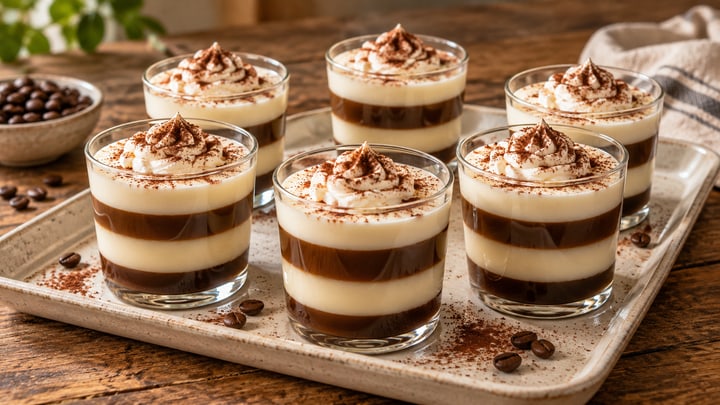 Layered Coffee and Milk Jelly
Where agar wins on speed: each layer sets in 10 minutes, outside the fridge.
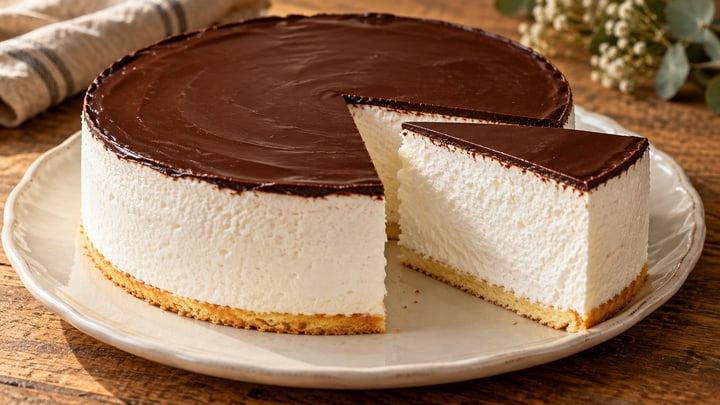 Bird's Milk Cake: Russian Soufflé Cake with Agar-Agar
A Russian cake whose soufflé holds thanks to agar, cooked into a syrup like an Italian meringue.
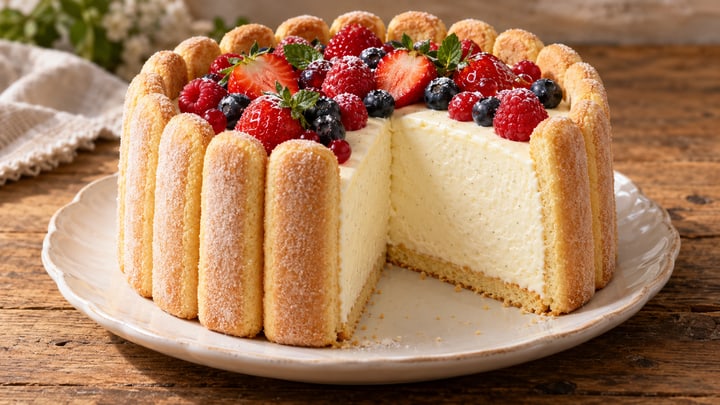 Charlotte Russe: Ladyfinger Cake with Bavarian Cream
The counterexample: a Bavarian cream that has to melt in the mouth, so it's made with gelatin.
 Panna Cotta – The Italian Classic
Panna cotta made with gelatin, to compare its wobbly texture with the agar version.
Frequently asked questions
- Is agar-agar the same as unflavored gelatin?
No. Both gel, but gelatin is animal-based (collagen) and agar comes from seaweed. They're also used differently: agar has to boil, sets at room temperature and doesn't melt in the mouth.
- How much agar replaces an envelope of gelatin?
There's no fixed conversion, because strength varies by brand and form. As a starting point, an envelope of gelatin (7 g) for half a liter of liquid is replaced with about 2 g of agar powder, which has to boil. And the swap doesn't work in every recipe.
- Why didn't my agar set?
Almost always because it didn't boil: dissolving it in a hot liquid isn't enough. The other causes are too little of it, or an acid that boiled along with the agar. In the first two cases you can boil it again and fix it.
- Does agar-agar have a taste?
Agar powder is practically neutral. Some lower-quality bars or strands can leave a faint sea taste if used in quantity.
- Can you freeze a dessert made with agar?
It's not a good idea: as it thaws it weeps water and the texture turns spongy. In the fridge it keeps well for three or four days.
Updated on 2026-09-29T01:29:15.576Z