What is fig-leaf gourd?
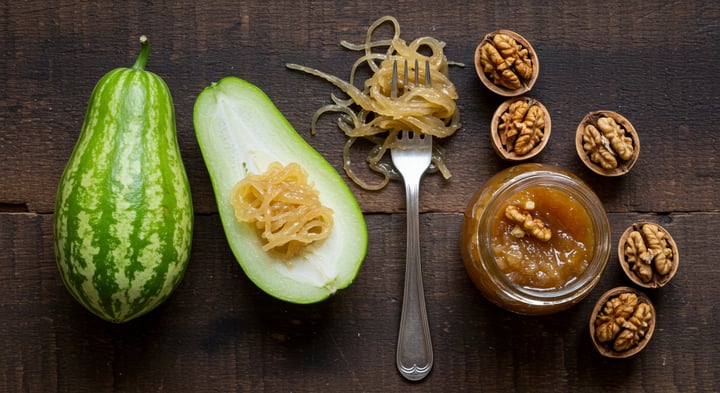
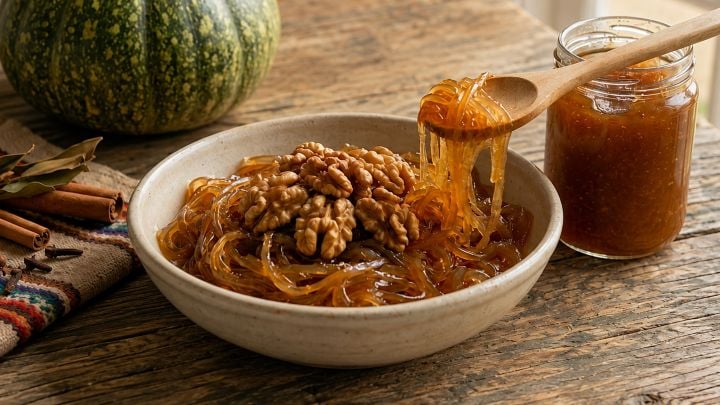
Cayote is a squash with a hard, green-striped skin — from the outside it looks like a small watermelon — whose flesh, once cooked, pulls apart into long strands instead of turning to purée. That texture is the whole point: cooked with sugar it makes a translucent preserve of amber threads that is the traditional dessert of north-western Argentina. In English it is the fig-leaf gourd; elsewhere the same plant is called chilacayote, alcayota or cidra cayote.
The strands are protected from the start
The flesh is pulled apart by hand or with a fork, following the fibre, and never cut with a knife. Cutting across it breaks the long threads and the preserve ends up in little pieces, which is exactly what you are trying to avoid.
That is why cayote preserve is unlike any other: it is neither purée nor jam, it is a skein of threads in syrup.
The same fruit, another name and another dessert
Spain makes cabello de angel from this same plant: it is the filling of ensaimadas, cocas and any number of pastries. Same principle — candied strands — with a different name and a different destination.
Chile calls it alcayota and Mexico chilacayote. The plant is Cucurbita ficifolia, distinct from ordinary squash and from pumpkin.
Where to find it
Outside Latin America it is rare under this name. Look for fig-leaf gourd, chilacayote or Malabar gourd in Latin American and Asian grocers.
The everyday substitute is spaghetti squash, which has the same strand structure and behaves very similarly when candied. It is the practical route in most of the US and Europe.
The recipe
Frequently asked questions
- Is cayote the same as squash?
No. It is a different species (Cucurbita ficifolia). The difference is mostly in the flesh: ordinary squash collapses into purée, cayote separates into long strands.
- Why does it look like a watermelon from the outside?
Because of the green skin with pale veining, which is very similar. Only when you open it does the white, fibrous flesh appear, which has nothing to do with it.
- How long does the preserve take?
Two to three hours over a very low heat, after macerating the flesh with sugar overnight. It is ready when the strands turn translucent and the syrup takes on an amber colour.
Updated on 2026-10-02