What is filo pastry?
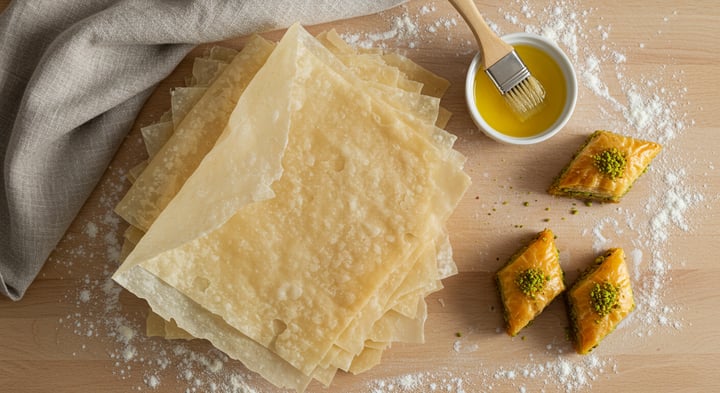
Filo is made of paper-thin sheets — under a millimetre — of nothing but flour, water and a little oil or vinegar, stretched until they are almost transparent. It is the base of baklava and of much of the pastry of the Middle East, Greece and the Balkans. The name comes from the Greek phyllo, meaning leaf. In the US it is often spelled phyllo.
Filo and puff pastry are not made alike and do not behave alike
Puff pastry carries the butter inside: successive folds laminate fat and dough, and in the oven the water in that butter turns to steam and pushes the layers up. That is why it rises.
Filo has no fat in the dough at all. The layers are built by stacking sheets and brushing butter between each one. In the oven it does not rise: it dries out and turns crisp and brittle.
So the result is different: puff pastry is airy and tall, filo is thin, dry and shatters. Swapping one for the other changes the dessert.
It dries in minutes: the damp cloth rule
It is so thin that in open air it loses moisture within minutes, and a dry sheet tears the moment you lift it.
The rule is simple: keep the stack covered with a barely damp tea towel and take one sheet at a time. Barely damp, not wet — if it drips, the sheets stick together and then they will not come apart at all.
Where to find it
In the US and the UK it is a supermarket item, in the freezer next to the puff pastry, labelled filo or phyllo. Middle Eastern and Greek grocers carry thicker and thinner grades.
If a recipe calls for a very thin one, look for the grade sold for baklava; the standard supermarket sheets are slightly thicker and take a little more butter between layers.
The recipes


Frequently asked questions
- Can I use puff pastry instead of filo?
You can, but the result is different. Puff pastry rises and stays airy; filo stays thin and brittle. For a baklava the difference is very noticeable.
- Can it be made at home?
Yes, but it is one of the hardest doughs: it has to be stretched over a cloth until it goes translucent without tearing. The shop-bought kind is good and it is what almost everyone uses.
- Does it freeze?
Yes, and in fact it is sold frozen. Thaw it in the refrigerator overnight: rushed in the microwave it turns into a sticky block and is unusable.
Updated on 2026-10-02