What is plantain?
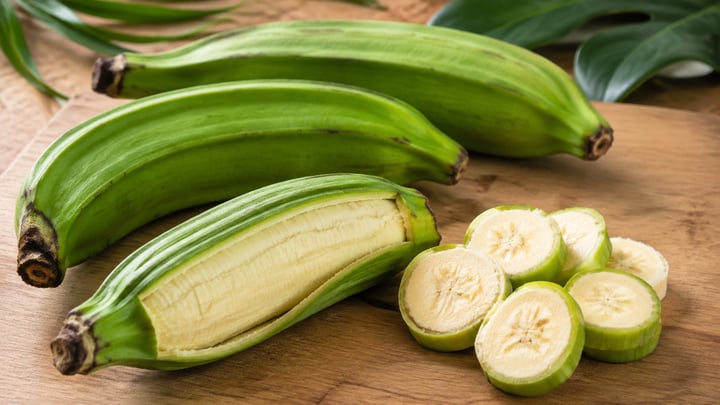
Not a green banana but a cooking variety of its own, never eaten raw. And green or ripe are two different ingredients, even though it is the same fruit.
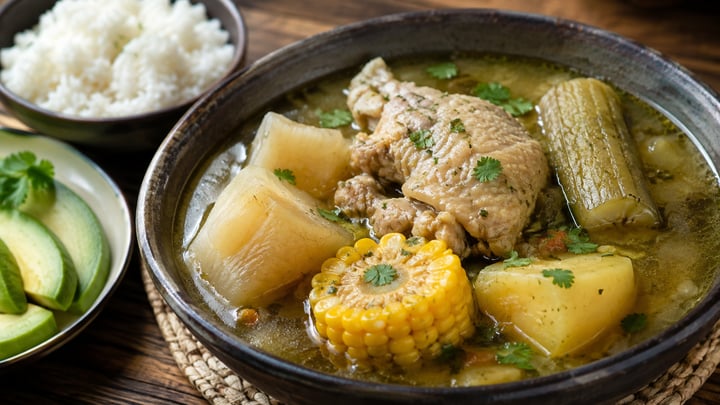
The plantain is a cooking banana: larger, with a thick, angular skin, high in starch and low in sugar. It is not an unripe dessert banana — it is a different variety, and it is not eaten raw even when ripe. It is the foundation of patacones, sancocho and much of Caribbean and Andean cooking.
It is not a green banana
This is the misunderstanding that ruins recipes. An unripe dessert banana is mealy and astringent, but it has neither the starch nor the texture of a plantain: fried, it will not flatten, it falls apart.
You recognise a plantain by its size — noticeably longer and thicker —, by the hard skin with pronounced ridges, and by the fact that it is not edible raw: it is starch, like a potato.
Green and ripe are two ingredients
The same fruit goes from green to yellow to black, and at each stage it is for something else.
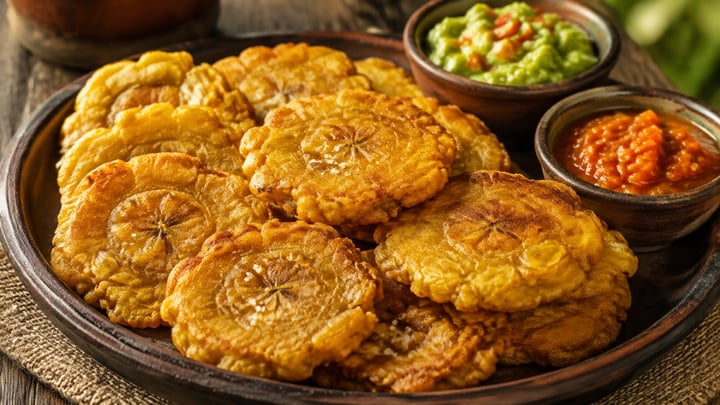
Green: hard, starchy, not sweet at all. This is the one for patacones, flattened and fried twice, and the one for sancocho.
Ripe (yellow with black patches): it softens and turns sweet. This is the one for fried slices, served alongside savoury dishes as a sweet accompaniment.
Black: intensely sweet and soft, almost jam. Used in desserts.
⚠️ Buying it ripe to make patacones is the classic mistake: it cannot be flattened and comes out sweet.
How to peel it, which is not obvious
The skin of a green plantain does not come away like a banana: it clings to the flesh and it is hard.
Cut off both ends, score the skin lengthways with the tip of a knife without reaching the flesh, and lift it off by pushing your thumb underneath.
If your fingers turn sticky, that is normal: the sap comes off with oil, not water.
What it is called elsewhere
The name changes a great deal, which makes it hard to search for: plantain in English; plátano macho or plátano verde in Mexico, Central America and much of South America; banana-da-terra in Brazil; Kochbanane in German; bakbanaan in Dutch; kokbanan in Swedish.
Where to find it
In Latin American, African and Asian grocers, where it is an everyday product. Increasingly in larger supermarkets too, usually among the exotic fruit.
Search by the local name of wherever you are — asking in Spanish does not always get you there.
Store at room temperature. Not in the fridge if you want it green: cold does halt ripening but blackens the skin and damages the texture. If it is already ripe and you will not use it, peel, slice and freeze it.
The recipes
Frequently asked questions
- Is a plantain a green banana?
No. It is a cooking variety of its own, with far more starch and far less sugar. An unripe dessert banana will not stand in: fried, it falls apart instead of flattening.
- Can I use ripe plantain for patacones?
No. Ripe is sweet and soft: it cannot be flattened and gives a different dish. Patacones need green, hard plantain; ripe ones are for fried slices.
- Can it be eaten raw?
No. It is starch, like a potato: raw it is astringent and hard to digest. It is always cooked — fried, boiled or baked.
- How do you peel it?
Cut off the ends, score the skin lengthways without reaching the flesh, then lift it away with your thumb. It does not open on its own like a banana.
Updated on 2026-09-05T13:45:30.312Z