What is self-raising flour?
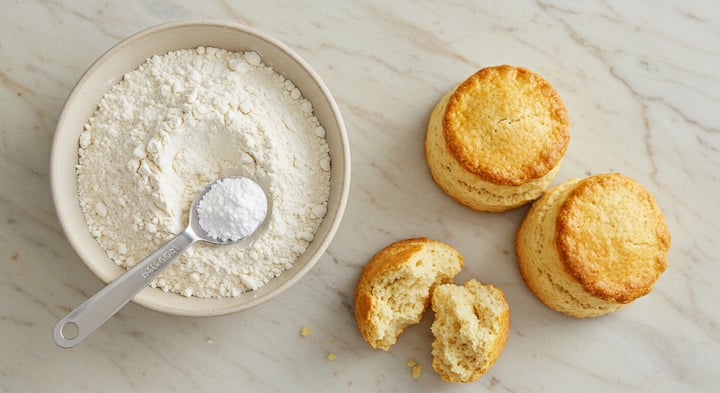
Self-raising flour is simply plain flour with the baking powder already in it — and sometimes a pinch of salt — blended at the factory in an even proportion. It contains nothing you cannot have at home: it exists for convenience, not for technique. In the United States it is labelled self-rising flour, and it is more common in the South than elsewhere.
The swap, for when you have run out
For every 100 g of plain flour, 1 level teaspoon of baking powder (about 4 g). Sift them together and that is it.
Do sift properly rather than just stirring: lumps of baking powder leave bitter patches and make things rise unevenly.
If the recipe has nothing acidic in it (yoghurt, lemon, buttermilk), the swap is direct. If it does and it also calls for baking soda, leave the baking soda alone: it is doing a different job.
When NOT to use it
In doughs that need a slow rise — yeasted breads, pizza dough, puff pastry — self-raising flour gets in the way: baking powder acts with heat and not with time, and it gives a crumb that is not what those doughs are after.
And in recipes where you want to control how much something rises, plain flour with the powder measured separately is better.
Which one to buy
In the UK it is a supermarket staple, right beside the plain flour. In the US it is sold as self-rising flour and is easier to find in the South; elsewhere it may not be on the shelf at all.
If you bake occasionally, buying plain flour and baking powder separately is better value: they cover everything, and the powder does not sit going stale inside a bag of flour you will take months to finish.
The recipes



Frequently asked questions
- How much baking powder is in self-raising flour?
Around 1 level teaspoon per 100 g of flour. Brands vary a little, but that proportion works for replacing it.
- Can I use self-raising flour where the recipe calls for plain?
Only if the recipe has no baking powder of its own, otherwise you double the raising agent and it rises too much and then sinks.
- Does self-raising flour go off?
Baking powder loses strength with time and damp, so yes: old self-raising flour lifts less. If it has been open more than a year, use plain flour and fresh powder.
Updated on 2026-10-02