What is southern king crab?
Centolla (Lithodes santolla) is the southern king crab: it lives in the South Atlantic and the channels of Tierra del Fuego, at the very bottom of South America. In English it usually gets called just «king crab», and that is where the confusion starts — that name normally means the Alaskan and Barents Sea species. They are two different species from two oceans. And neither one is a true crab.
Not a true crab: count the legs
The evidence is right there: a centolla shows three pairs of walking legs, plus the claws. A true crab has four pairs plus claws.
The fourth pair did not disappear: it sits shrunken and tucked under the edge of the shell, inside the gill chamber, where it keeps the gills clean.
King crabs descend from hermit-crab-like ancestors and only later took on a crab shape. One more giveaway: the right claw is always bigger than the left.
Centolla, centollón, and Alaskan king crab
Centolla (Lithodes santolla): from the Beagle Channel and Tierra del Fuego. Spiny shell, long legs. The largest and priciest of the three.
Centollón (Paralomis granulosa): same waters, similar from a distance, but smaller and with a grainy shell instead of a spiny one. Less meat, considerably cheaper. Not a young centolla — a separate species.
Alaskan king crab (Paralithodes camtschaticus): the Alaska and Barents Sea one, the crab-boat television star. It is a cousin of the centolla — same family — but a different species from a different ocean.
Why it always comes pre-cooked
The meat spoils fast once the animal dies, so centolla is cooked as soon as it leaves the water, on board or at the dock, and then frozen. What you buy is already cooked, whole or picked.
That leads to the most useful line on this page: at home you reheat it, you do not cook it. A few minutes in a hot oven is enough.
Cook it through a second time and the meat turns stringy and dry, losing the sweetness you paid for.
The exception is at the very bottom of the map: restaurants in Ushuaia keep tanks where the centollas wait alive and you pick your own. That meat never saw a freezer — and that, not the scenery, is why the southern one tastes different.
Seeing them in there comes with a surprise: centolla is already red while alive. Almost every other crustacean is brown or greenish and turns red only when cooked; here the pigment is already on show, and cooking just evens out the tone.
Males only, and only above a minimum size
The Tierra del Fuego fishery takes males only, and only above a minimum size. Females go back in the water, and so do undersized males.
That is why the centollas that reach the table are big: nobody is picking the best ones — the small ones are never landed.
They are caught in baited traps set on the seafloor rather than by trawling, so anything that does not qualify can go back alive.
That control is also where the tags fastened to one leg come from — the ones you see in restaurant tanks. They identify the animal from the boat onward, and they are the visible end of a system meant to keep the fishery from eating through its own species.
How much meat is actually in there
A whole centolla is mostly shell. A kilo of live animal yields roughly 250-300 g of meat, which is the real explanation for the price.
The best part is the legs, which give whole batons of firm meat. The claws are similar. The body gives shredded, stringier meat that goes into fillings, sauces, and gratins.
Pre-picked meat in a jar is mostly that body meat — which is why it costs less than legs.
How to eat a whole centolla
When it arrives whole, it arrives with scissors — not as a flourish, but because they are the right tool. You cut the leg lengthwise along the softer side of the shell, and the baton of meat comes out in one piece.
Mallets and crackers belong to other shellfish. Here they crush the shell inward, mix splinters into the meat, and destroy the very baton you were after.
Open the body by lifting the shell from the back. Between the chambers there is shredded meat, more work to get at but just as good, plus the creamy orange part, which has as many fans as detractors.
It is served warm or cold, with lemon or a light mayonnaise. It rarely needs more: the meat is already sweet, and a heavy sauce covers exactly that.
Why it is the symbol of Ushuaia
In Tierra del Fuego the summer is short and cool, and the list of what grows outdoors is short with it. Much of what fills a greengrocer arrives from elsewhere, thousands of kilometers away.
That makes whatever really is local count for more. The Fuegian table is defined by the sea and the scrub: centolla, Patagonian toothfish, lamb — and calafate, the purple berry behind the jam and the liqueur in every shop window.
Centolla is not the emblem of the city because of a campaign: the list of things Ushuaia can call its own is short, and this is by far the most spectacular of them.
Where to find it
Outside South America it is almost always frozen, at a good fishmonger or online — whole and cooked, or picked. Check the origin: Argentina or Chile means centolla, while Norway, Russia, or Alaska means the northern species.
Meat in a jar or can is picked body meat: good for gratins, sauces, and fillings, and much cheaper than legs.
⚠️ Imitation crab sticks are not crab. Surimi is molded white-fish paste, flavored to suggest it.
Thaw it overnight in the refrigerator and drain the water it releases. Rushing it under warm water makes the meat fall apart.
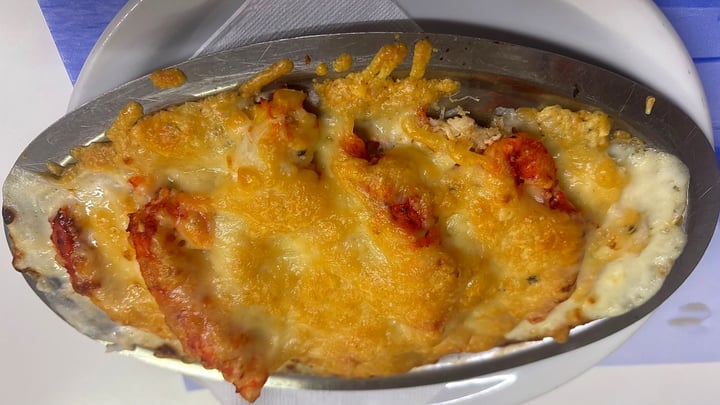
The recipe
Frequently asked questions
- Is centolla the same as Alaskan king crab?
No. They belong to the same family but are different species from opposite hemispheres: centolla is Lithodes santolla from the South Atlantic, while the Alaska and Barents Sea crab is Paralithodes camtschaticus. Both get called "king crab" in English, which is where the mix-up comes from.
- Is it a true crab?
Strictly speaking, no. You can see three pairs of walking legs instead of four, because it is a lithodid — a group related to hermit crabs that evolved into a crab-like shape. The fourth pair exists but is shrunken and hidden under the shell.
- How is it different from centollón?
Centollón (Paralomis granulosa) is its own species, not a young centolla. It is smaller, has a grainy shell rather than a spiny one, and yields less meat. It costs considerably less.
- How do I reheat it without ruining it?
It is already cooked, so it only needs heat: a few minutes in a hot oven, or a quick pass in a skillet (frying pan). Cooking it through again leaves the meat dry and stringy.
- What do you eat a whole centolla with?
Scissors. You cut the leg lengthwise along the softer side of the shell and the baton of meat comes out whole. A mallet crushes the shell inward and mixes splinters into the meat, so it is the wrong tool here.
Updated on 2026-10-02